
Don’t Let Document Infrastructure Stall Your MVP
Why Building an Internal Document Engine is a Trap
Startups win when they focus. High-performing teams don’t waste precious engineering hours on auxiliary infrastructure. Instead, they seek out the right APIs to do the heavy lifting—integrating Stripe for payments, Auth0 for identity, and Twilio for communications. This allows them to preserve their firepower for what truly matters: their core business logic, not the plumbing.
Yet, when it comes to document workflows—editing, viewing, and rendering natively—this strategic focus often fractures. Many teams fall into the Build Trap, naively assuming a few open-source libraries will suffice.
Ask yourself: Is your team building innovation, or are they stuck in the weeds of document infrastructure maintenance? Building your own document infrastructure isn’t just a feature request; it’s a critical bottleneck that can stall your MVP indefinitely. Here’s why.
The Open-Source Illusion: Engineering Overhead
“The moment a user clicks ‘Save,’ your backend must reconcile flexible web data with thousands of rigid, low-level rendering instructions. If even a single font metric is off, the document breaks. Is it really a rational use of resources to have senior engineers on six-figure salaries maintaining a ‘pixel-perfect’ rendering engine? Overlooking these hidden costs makes true cost optimization impossible, turning your internal solution into a financial drain.”
Integrating a simple WYSIWYG library is not the same as building a production-grade document engine. When you mistake rich-text input for a complete document solution, you trigger a cascade of hidden engineering debt.
1. The HTML-to-Binary Gap
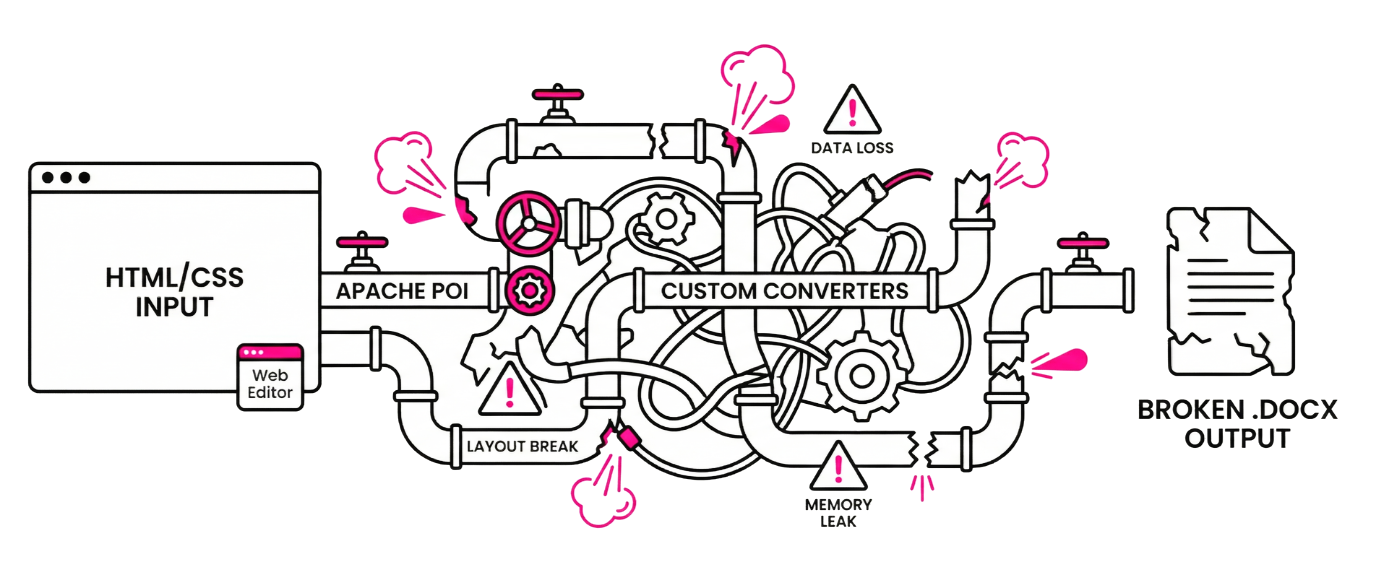
Web editors handle data in HTML/CSS, but your users expect results in .docx or .xlsx. To bridge this gap, many developers turn to Apache POI, the standard Java library for OOXML.
However, the real headache is the structural mismatch between the web’s fluid box model and rigid document standards. While Apache POI offers the plumbing, it lacks a layout engine. This forces your team into a “Middleware Nightmare”—manually hacking translation logic for nested tables and CSS-to-binary styles that open-source tools simply weren’t built to sync.
2. The Not-so-WYSIWYG Reality
Users take it for granted that what they see on the screen is exactly what will be printed or exported. Guaranteeing this with a patchwork of open-source libraries is nearly impossible.
Even if you bridge the web DOM to Apache POI, you’ll hit a wall with Layout Integrity. Minor discrepancies in font rendering and line spacing lead to broken exports—displaced signatures or overlapping headers. Debugging these inconsistencies is so complex it eventually requires a dedicated team, draining resources from your core MVP goals.
3. Document Processing and Infrastructure Hell
Document processing is resource-intensive and notorious for unpredictable memory spikes. Because complex formats like .docx and .pptx are difficult to stream, your system must often handle massive heap allocations in real-time.
While you can mitigate this by building distributed worker groups and message queues, it creates a significant infrastructure tax. You end up managing complex scaling logic and resource-heavy microservices—efforts that have nothing to do with your core product’s value proposition.
4. Container Bloat and Scaling Latency
A production-grade document engine requires extensive font libraries and native binaries, leading to significant Container Image Bloat. Larger images slow down your CI/CD pipelines and, more critically, increase Cold Start latency during autoscaling events. This undermines the stateless agility of modern cloud architecture, making it harder for your MVP to respond to sudden traffic surges without over-provisioning or manual oversight.
In short, open-source looks free, but it is often the most expensive route when measured in engineering hours.
The Big Tech API Trap: Loss of Sovereignty and UX Decay
Switching to the Google Docs API to avoid infrastructure pain is often jumping out of the frying pan and into the fire. The Google Docs API does not natively control industry standards like OOXML (.docx) or ODF (.odt). To use the API, you must convert your files into Google’s Internal Schema.
The problem is that this isn’t a 1:1 mapping—it’s a translation. Complex styles and precise layout metadata that the Google engine doesn’t recognize are lost or distorted. When you finally export the document back to a standard format, the user is left with a degraded version of their original file. For business services where Document Integrity is non-negotiable—like contracts or official reports—this is a fatal flaw.
Even the Microsoft Graph API, which supports OOXML natively, brings its own baggage. For an MVP-stage startup, the administrative and technical overhead of Azure AD configuration, permission scoping, and Tenant ID management is a massive tax on engineering speed.
Most critically, both Google and Microsoft impose a “Login Wall.” Imagine your user being hit with a Google login modal just to use a feature in your app. When functionality doesn’t live seamlessly within your brand’s web application, the user experience breaks, and you surrender your product’s sovereignty to Big Tech.
The Perfect Third Way: Thinkfree Office Hosted API
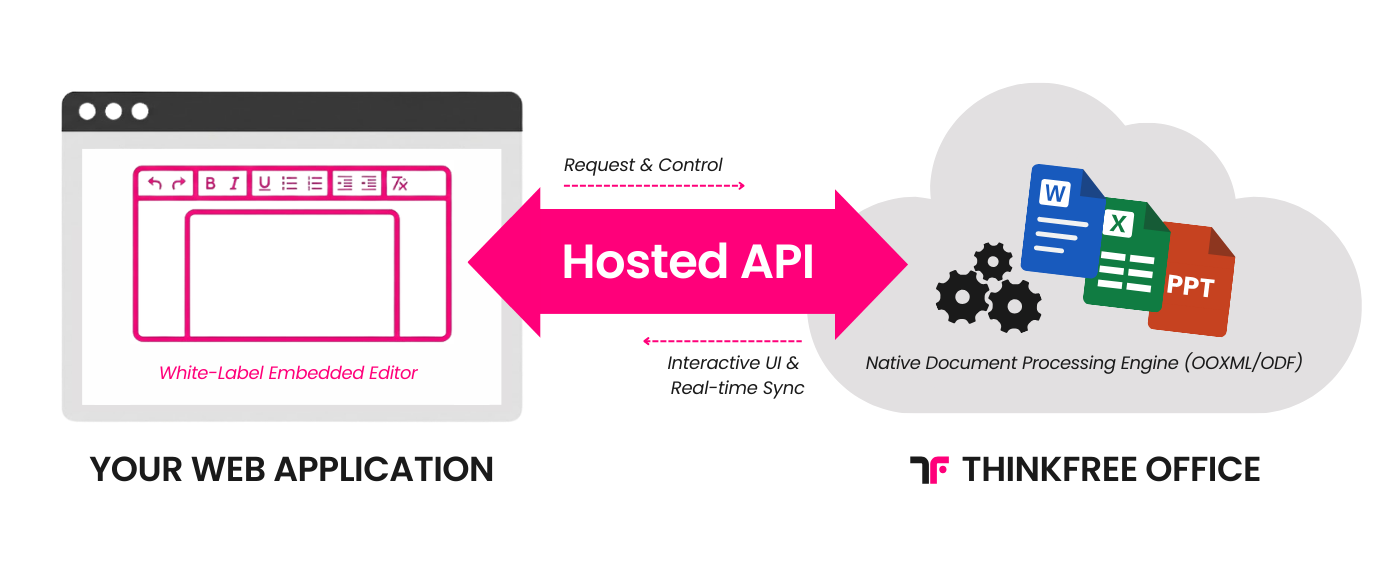
For teams caught between DIY and Big Tech, Thinkfree offers a third way: a scalable document infrastructure featuring an embedded document editor API that’s easy to integrate.
1. Proven Document Tech: Native & Standard Compliance
2. Managed Compute Efficiency
The heavy lifting of high-performance document processing and rendering happens in the Thinkfree cloud. This keeps your server infrastructure Stateless and agile while delivering enterprise-grade performance.
3. True White-label Integration
Want to provide a seamless UX? Simply call our API within your system. Thinkfree is designed to be embedded naturally, ensuring your brand experience remains uninterrupted.
4. Financial Agility: Pay-as-you-go
For startups where demand is still scaling, our Pay-as-you-go model is the perfect fit. Manage your costs in line with your growth, from the earliest MVP stages to global scale, without financial risk.
Category | Open Source (Build) | Big Tech APIs (Google/MS) | Thinkfree Hosted API |
|---|---|---|---|
Engineering Focus | High Risk (Constant DIY fixes & pipeline maintenance) | Restricted (Managed infra, but zero control over core logic) | Optimized (Focus 100% on your product features) |
User Experience (UX) | Flexible (But labor-intensive to maintain UI polish) | Limited (Login walls and forced third-party branding) | Seamless (True White-label with natural embedding) |
Business Agility | Low (MVP release is often delayed by infra building) | Medium (Locked into platform policies & licenses) | High (Pay-as-you-go model for fast market entry) |
Ship Faster, Scale Smarter
Every great service starts by solving a core problem. For a growing startup, wasting time on document infrastructure is a costly strategic error.
Don’t spend your time reinventing the wheel or trying to fit your product into a massive, rigid machine. Let Thinkfree handle the document complexities so your team can focus on the innovation that only you can provide.
Join Us as a Founding Partner
Thinkfree is currently looking for Early Bird Partners to solve real-world technical challenges alongside us. Don’t just be a customer—be a Founding Partner.
We are ready to provide an engineering hotline and exclusive benefits to ensure your team hits the market without technical barriers.
“Don’t reinvent the wheel. Just drive it.”
Release your MVP the smart way with the Thinkfree Office Hosted API today.
Like this post? Share with others!