A Decision for a Century of Data: Why IT Leaders Must Prioritize the ODT Format
The Convenience Trap: Is Your Intellectual Property Locked In?
In the era of SaaS, where all data flows into the cloud, IT leaders often overlook a critical question: “Do the tens of thousands of documents we produce daily truly belong to our organization, or are they merely rented from a platform?”
Today, corporate intellectual assets are deeply synchronized within the ecosystems of Big Tech giants under the guise of convenience. However, in the face of sudden vendor policy changes or unexpected service availability risks, your data remains vulnerable. If you were unable to use your current software tomorrow, could you fully extract and interpret the records that constitute your organization’s past and present? It is no longer just about software choice, but about ensuring ODF and docx compatibility as part of a long-term data preservation strategy.
True data sovereignty is not achieved simply by keeping hardware on-premises. If the format in which data is recorded lacks independence, it is akin to installing a lock in your own backyard that you do not hold the key to. It is time to discuss document standards as a sustainable asset strategy and a viable “Exit Strategy.”
Standards Are Insurance for the Future, Not a Cost
Document formats have long been hidden beneath the technical layer, viewed merely as tools for operational convenience. However, when viewing the entire data lifecycle, formats become a core economic indicator directly linked to business resilience.
- Operational Risk Management: Layout glitches or macro errors that surface with every software update are not mere inconveniences. They represent management costs arising from vendor dependency and are the primary culprits behind massive switching costs during system migrations.
- Strategic Bargaining Power and Interoperability: Genuine standards guarantee the seamless movement of data across platforms. Only when this interoperability is secured can IT decision-makers exercise real technical autonomy—choosing alternatives without being held hostage by a specific vendor’s monopolistic pricing.
The Core of the Issue: Data Architecture
Why do specific formats create such powerful lock-in? The answer lies not in the visual appearance of the document but in how the data is defined and packaged internally.
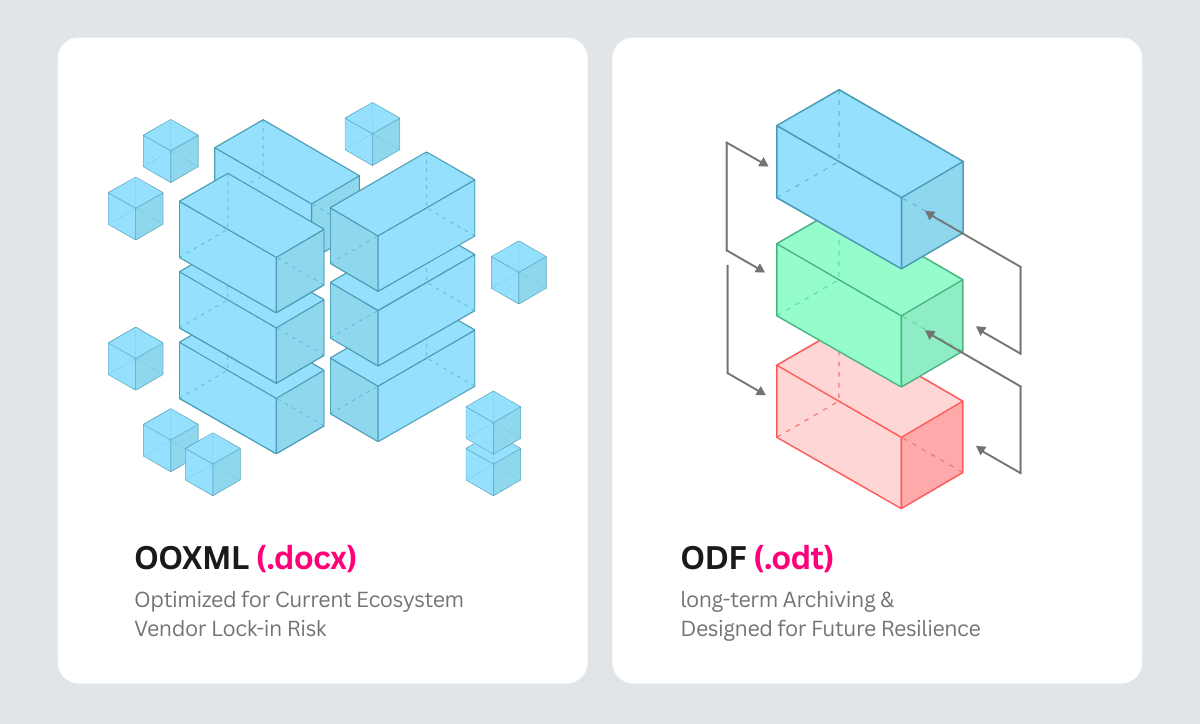
1. OOXML (.docx): A Massive Legacy Focused on Presentation
As Microsoft dominated the word-processing market in the 1990s, its proprietary binary format (.doc) became the de facto standard. When the Open Document Format (ODF) was adopted as an ISO/IEC international standard in 2006, Microsoft responded by migrating its complex legacy code into XML, resulting in OOXML. As the current global business standard, OOXML provides exceptional visual fidelity and workflow continuity. However, its architecture is inherently complex because it must support decades of legacy attributes.
- Fragmented Legacy: Rooted in proprietary software, OOXML is less a modern data specification and more a translation of decades of technical debt into XML. Its specification exceeds 6,000 pages because it must accommodate non-standard legacy attributes alongside modern design.
- Packaging Complexity: Furthermore, a DOCX file is a labyrinth of XML files intertwined with complex relationships. To interpret a single style, the engine must reference data across multiple folders, significantly increasing the probability of rendering errors when parsed by third-party developers.
2. ODF (.odt): A Lean Design Focused on Interoperability
Technical Compactness: ODF features a clear, intuitive division of labor—content.xml for data and styles.xml for definitions. The XML schema is hierarchical and logical, making it easy for engineers to navigate and highly predictable for data extraction.
Structural Transparency: ODF follows the gold standard of open packaging. By minimizing unnecessary references, it maintains efficient file sizes. It is a data-centric standard ensuring that even 100 years from now, anyone with the standard specification can restore the data to its original form.
Category | OOXML (.docx, etc.) | ODF (.odt, etc.) |
|---|---|---|
Core Value | High-fidelity Compatibility
(Visual reproduction of legacy assets) | Interoperability & Openness
(Cross-platform data sovereignty) |
Structural Trait | Extended XML (Vast schema including legacy binary attributes) | Strict XML (Intuitive, hierarchical, data-centric schema) |
File Structure | Complex packaging based on multi-reference relationships | Linear packaging with clear functional separation |
Data Sovereignty ODF: An Inevitable Shift
Ultimately, transitioning formats to secure data sovereignty is no longer optional; it has become a cornerstone of global IT governance. Major governments and institutions worldwide are adopting open document standards to escape vendor lock-in and ensure permanent access to information.
This global shift is built on technical trust. Beyond the proven ODF 1.3 standard, the approval of the ODF 1.4 specification by OASIS in late 2025—which features enhanced security and accessibility—has solidified ODF as an essential roadmap for risk management.
Success in data independence depends on how faithfully a solution adheres to these verified standards. Thinkfree is the partner that most authentically implements the value of these international standards in the business field.
Technology That Defies Time: Why Thinkfree Pursues Standards
Thinkfree offers the most realistic balance between technical convenience and core principles.
As the world’s first online office suite, Thinkfree Office provides industry-leading compatibility with OOXML, ensuring seamless business continuity. However, we go further by embracing a “Dual-Track” strategy: delivering high-performance OOXML support for today’s productivity, while simultaneously securing your data in the ODF standard for long-term independence. While you may communicate in OOXML for daily efficiency, we believe your records should be safely archived in a native ODF environment to guarantee true data sovereignty. Consequently, this ensures you never have to choose between immediate operational performance and future-proof digital safety.
The Mission: 100-Year Data Survival
In addition to operational efficiency, we prioritize the fundamental integrity of your information. By adhering to the Strict ODF specifications defined by the ISO, we aim for a native standard environment where document data is not dependent on a specific platform’s interpretation. To illustrate, ensuring that data survives intact in any environment 100 years from now is more important to Thinkfree than temporary, flashy layouts.
Furthermore, this philosophy is realized through Thinkfree Drive, a secure sovereign infrastructure. By controlling the entire process—creation, storage, sharing, and management—within a corporate on-premises environment, organizations can build a self-sustaining data ecosystem independent of closed vendor policies. As a result, users work as usual while the system quietly refines and stores data in standard formats. In short, Thinkfree provides a frictionless path to reclaiming data sovereignty without disrupting the user experience.
Control or Comply: The Start of Your Data Exit Strategy
The core of future-ready IT governance is exercising permanent authority over the data your organization creates. Rather than settling for familiar tools, leaders must make the strategic decision to ensure data portability and preservation. Data trapped in closed, proprietary syntax becomes a liability over time; data recorded in the language of standards becomes an irreplaceable asset.
In conclusion, Thinkfree Office and Drive are the most strategic choices for achieving your corporate data independence. We empower organizations to reclaim sovereignty through technical self-reliance rather than dependency.
Break free from vendor lock-in.
Discover the most realistic Data Exit Strategy with Thinkfree. 👉 Contact Us
Like this post? Share with others!