

Public cloud office suites don’t just store your files, they generate telemetry, shadow logs, and structural metadata that never fully leave the vendor’s infrastructure. This article covers the hidden data flows behind Microsoft 365 and Google Workspace, and what enterprises need to check: telemetry and shadow logs, data residency vs. data sovereignty, and vendor lock-in risk.
The office productivity software market has undergone a major paradigm shift. The era of standalone software installed on local PCs is fading. Today, the Software as a Service (SaaS) model is the standard. Microsoft 365 and Google Workspace now dominate the global market.
However, this transition to the public cloud is not always welcome for those who must directly control infrastructure and respond to regulations. Moving to the public cloud introduces significant uncertainty in data governance. A critical yet often overlooked issue is the continuous, passive collection of data that occurs without the knowledge of users or administrators.
More specifically, these traces are often called digital footprints. Much like the cookies generated when browsing a website, they are produced automatically every time an employee edits or saves a document. Once this data reaches a Cloud Service Provider (CSP) server, external infrastructure begins to govern a company’s core strategic assets. For many organizations, this is where data residency requirements first begin to fall short.
Public cloud offices store more than just files. SaaS office data collection goes far beyond simple service improvement logs. From a cloud data governance perspective, this data maps a company’s business processes and security posture at a higher-order level. Microsoft 365 and Google Workspace collect data in three primary categories.
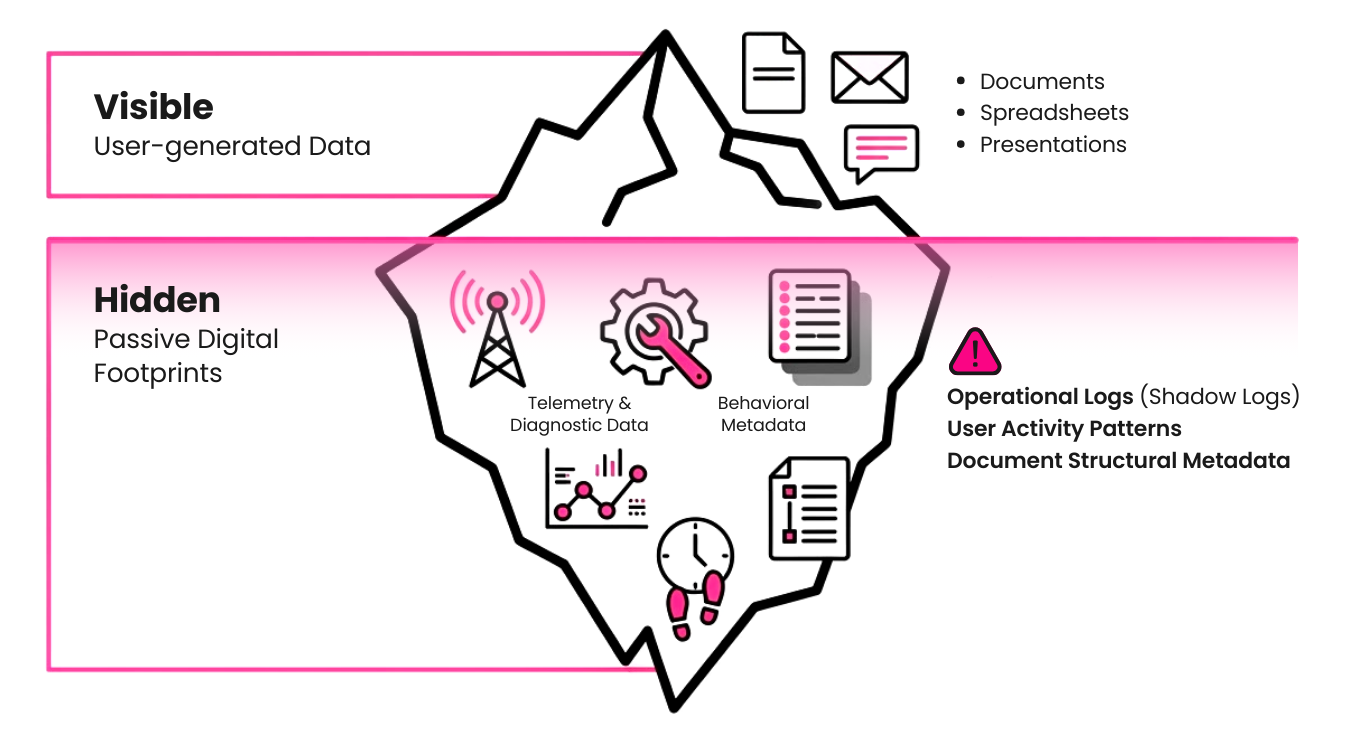
Vendors collect this data under the guise of service availability and performance optimization.
Beyond basic status data, it captures structural metadata and user work patterns. This extends to email subjects or sentences processed through office tools like translators and spell checkers. The issue is that this may contain sensitive information that CIOs must not ignore. This creates a data exfiltration risk, potentially exposing confidential project names and internal structures to outside parties.
In a SaaS architecture, all operations are processed on the vendor server. CSPs generate server logs and temporary snapshots beyond the company’s visibility, ostensibly for system optimization and disaster recovery.
Even after deletion, traces may linger deep within vendor infrastructure as shadow logs, governed by the CSP’s backup policies. The company retains no authority over the permanent destruction of this data.
Most recently, this has become the most contentious area as competition in large language models (LLMs) intensifies.
Once fed into a vendor’s AI engine under the banner of anonymization, companies have no way to track how their unstructured data is being reprocessed.
As regulations tighten, CIOs face a growing gap between data residency requirements and SaaS compliance.
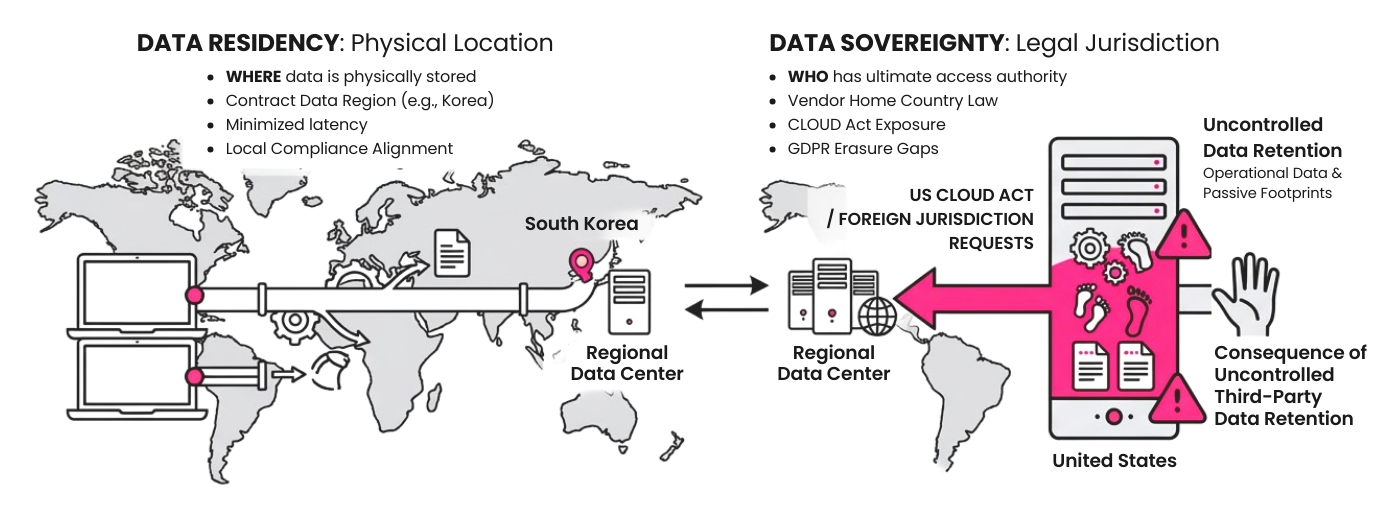
When using a US-headquartered CSP, companies face a legal risk that data may be disclosed upon request by the US government, regardless of where it is physically stored.
Permanent deletion is simply not possible. Administrators cannot control operational logs left on third-party servers, nor ensure their irreversible destruction. This creates a technical defect when companies must comply with the GDPR right to be forgotten or other strengthened privacy laws.
Data residency refers to the location of the data, while data sovereignty refers to the legal jurisdiction applied to that data. In a public SaaS environment, operational logs transmitted to a vendor’s home country create a gray area of data leakage. This is a major obstacle to achieving true data sovereignty.
Compounding this risk, vendor lock-in in cloud computing is more than a matter of cost. As a company becomes deeply integrated with a specific vendor, it loses the ability to establish independent security policies. When a vendor changes its terms or restructures its service, a company with terabytes of data locked in finds it nearly impossible to push back. Ultimately, the security architecture of the company becomes dependent on vendor policy.
Indeed, the risks mentioned above are no longer theoretical. Legal and technical conflicts arising from surrendering data control to public cloud vendors are being reported worldwide.
In 2013, the US government requested user information stored in a Microsoft data center in Ireland. MS refused based on local laws, but this case became a decisive factor in the enactment of the US CLOUD Act. This demonstrated that even when a data center resides within a country’s own borders, US legal jurisdiction still applies to the data if the vendor is a US-based company.
Beyond jurisdictional reach, educational authorities in the German state of Hesse have prohibited the use of Microsoft 365 in schools. The primary reason was the non-transparent collection of telemetry data. Authorities concluded that automatic metadata transmission to US servers for software performance checks violated General Data Protection Regulation (GDPR).
Global cloud companies are recently revising their Terms of Service (ToS) to use unstructured customer data for AI model training under the pretext of service improvement. In a SaaS environment, a single line change in a vendor’s terms can allow corporate knowledge assets to be absorbed into another company’s AI engine.
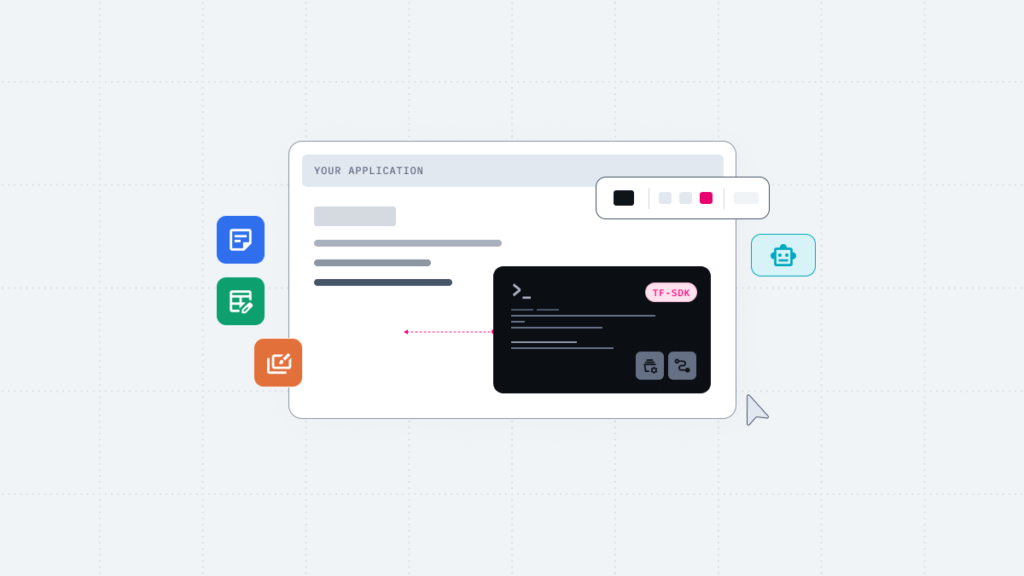
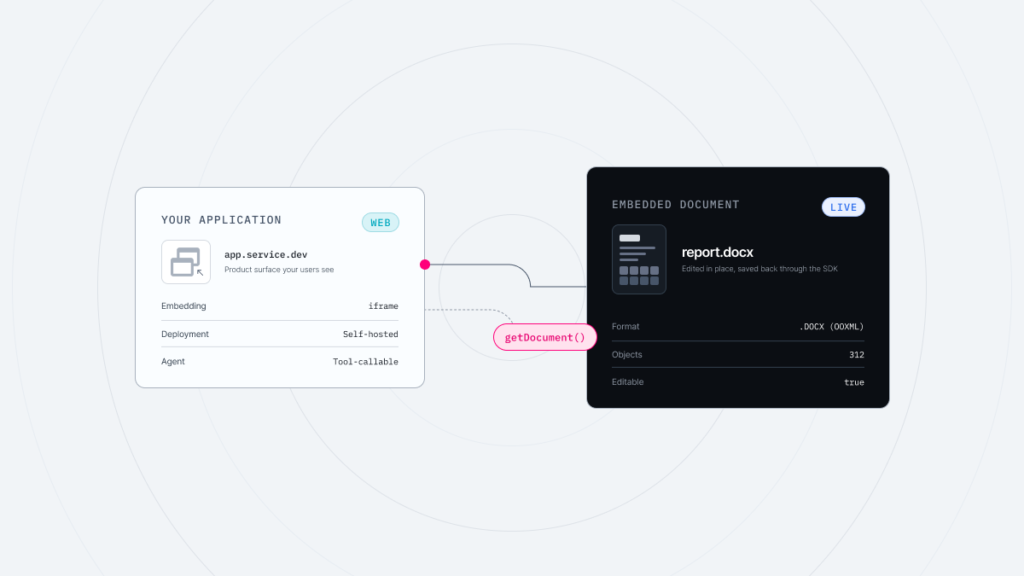
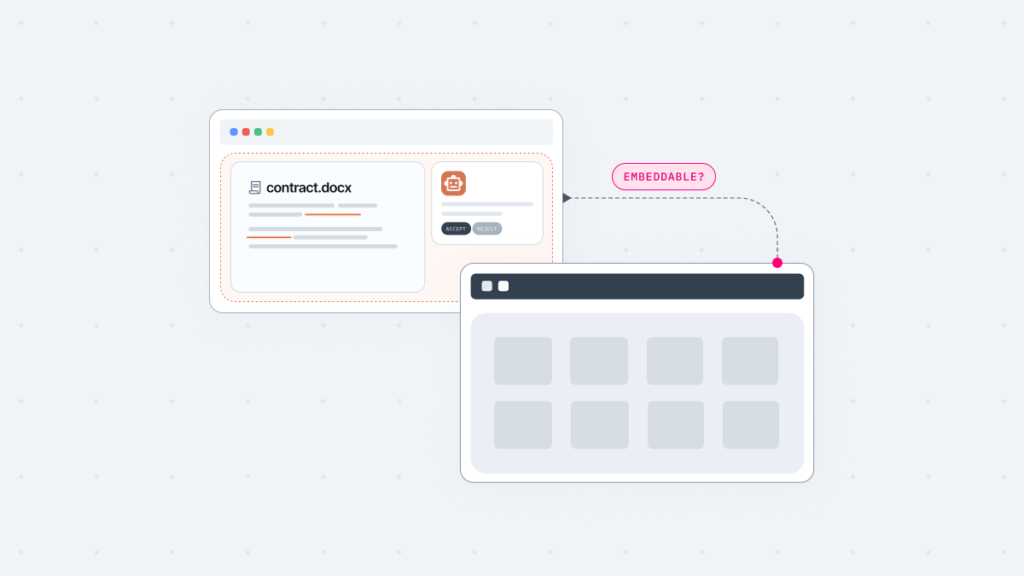
Thinkfree Office is now offered as Thinkfree Document Editor SDK for embedded document editing, object-level APIs, and AI agent integration.
This is precisely the paradox Thinkfree Office is designed to resolve. It offers a self-contained architecture deployed on infrastructure directly owned by the enterprise.
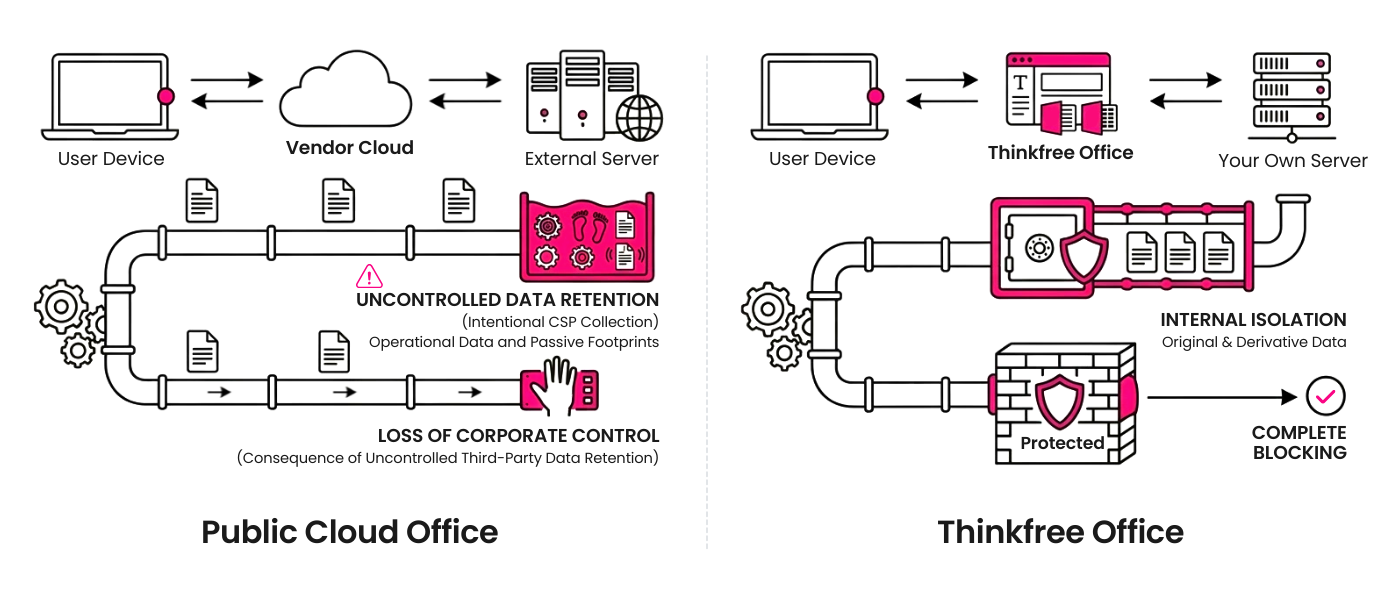
Thinkfree Office is currently proving its value through actual operations by global tech leaders and public institutions where data integrity and security are vital. A global 3D and PLM solutions company with over 25 million users adopted the Thinkfree Office engine to strengthen document governance across its platform. Within a massive ecosystem dealing with core design data and R&D assets for the aerospace and automotive industries, Thinkfree has proven both its high compatibility with Microsoft Office and its data isolation capabilities.
Furthermore, a prominent regional administrative agency in an advanced Asian country is securing its digital autonomy through Thinkfree Office. Rather than exposing citizen data to the public cloud, they have built a work environment fully independent of foreign jurisdictional risks.
True data governance is only achieved when a company can control not just the visible files, but every passive digital footprint generated throughout the document lifecycle.
Do not leave your core assets in a vendor’s infrastructure in the name of SaaS convenience. Thinkfree Office restores data sovereignty to your organization through a secure collaboration environment that leaves no trace on vendor servers.
Are you reviewing an architecture that can truly guarantee data sovereignty?
Like this post? Share with others!