“This is not a recommendation or a preference, it is a mandate.”
— Florian Effenberger, Executive Director of The Document Foundation
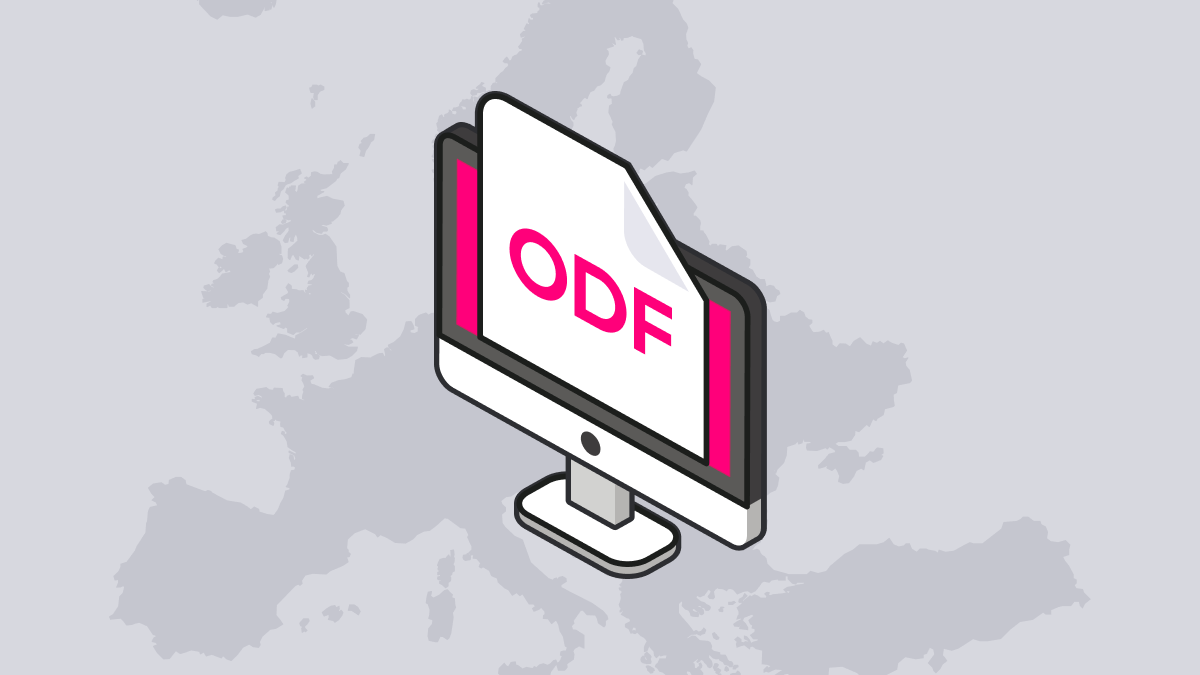
On March 18, 2026, the German IT Planning Council (IT-Planungsrat) announced a landmark decision. From now on, ODF and PDF/UA are the only authorized document formats across all levels of German public administration. Notably, Microsoft’s OOXML has been excluded from this list.
For enterprises evaluating ODF-supported online office solutions, this policy shift is more than a local regulation. It marks a turning point in a long-standing EU-wide movement to strengthen open standards and data sovereignty. Once format policies are established, they become difficult to reverse. Therefore, enterprises must evaluate whether their current document strategies can meet future public procurement requirements, regulatory compliance, and long-term preservation needs.
This article is essential for:
ODF (Open Document Format) is an open file format for office documents, including ODT for text, ODS for spreadsheets, and ODP for presentations. Defined under the international standard ISO/IEC 26300, its latest version is 1.4.
The core value of ODF lies in its vendor neutrality. Unlike formats tied to a specific vendor, ODF was designed from the ground up to remain independent. Its XML-based architecture enables flexible implementation and access across any operating system or platform. This stands in fundamental contrast to OOXML, which originated from converting decades of Microsoft legacy code into XML. Where OOXML is optimized for compatibility within the Microsoft ecosystem, ODF is built to be an open standard that any vendor can implement.
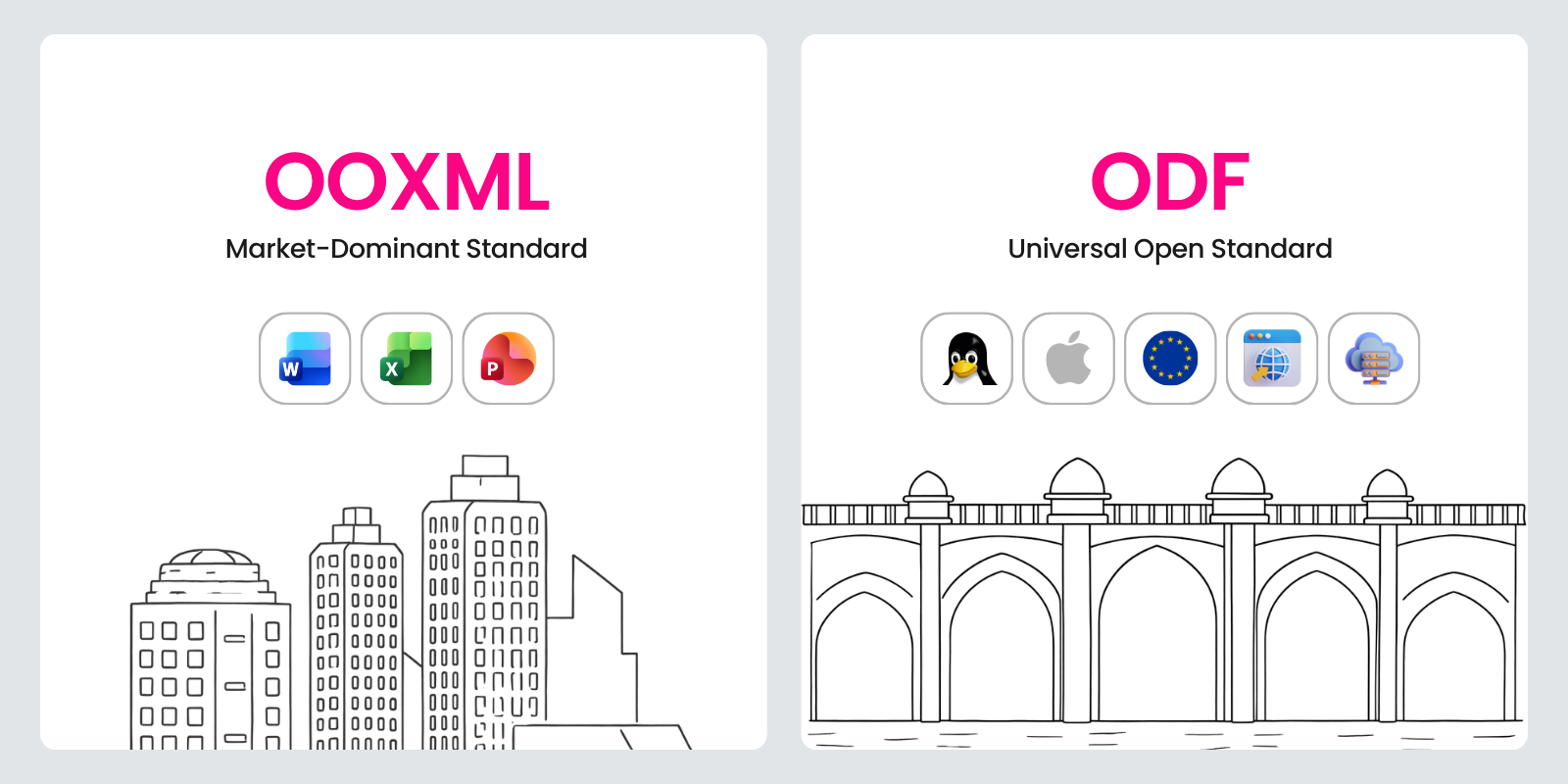
The Deutschland-Stack framework establishes the technical standards for a shared, sovereign digital infrastructure. This framework is built on a principle to reduce vendor lock-in and ensure data sovereignty. It demands open interfaces and local data storage to eliminate vendor lock-in. Their goal is to build specific infrastructure components for all government departments by 2028.
Admittedly, the immediate binding force of this decision is subject to discussion. The Deutschland-Stack resolution states that federal, state, and local governments should “strive” to comply with ODF standards when developing new systems. No specific sanctions or audit obligations for non-compliance were mentioned. Consequently, existing Microsoft-dependent infrastructure is unlikely to face an immediate overhaul.
Nevertheless, these limitations do not diminish the significance of the policy direction itself. Germany adopted this through the IT-Planungsrat, which includes the federal government, 16 states, and many municipalities. The 2028 target makes clear that this is far more than a suggestion. France mandated ODF in its 2009 Interoperability Framework and has since continuously reinforced its implementation. The UK also adopted ODF in 2014 as the sole standard for sharing and collaborating on editable documents. Other nations, such as the Netherlands, Sweden, Norway, and Denmark, have also implemented policies to encourage or mandate open document formats in public administration.
While implementation challenges remain, ODF support is becoming increasingly important across the EU.
Since ODF mandates are currently concentrated in the public sector, some may assume they have no bearing on private business. However, the reality is quite different for several reasons:
Companies supplying the German government must be able to submit official documents, contracts, and reports in ODF format. As the 2028 deadline approaches, this will become a hard requirement in procurement bids.
If the EU Interoperable Europe Act (IEA) establishes ODF as the de facto standard for inter-agency document exchange, any private firm dealing with public institutions must ensure ODF compatible workflows.
Companies with partners or branches in ODF-mandated countries like Germany, France, or the UK may face operational friction due to document format mismatches.
Storing long-term documents like contracts or medical records in vendor-dependent formats is a significant risk. As an ISO standard, ODF supports long-term access regardless of a vendor’s lifecycle or policy changes. This is a critical requirement for any online office strategy.
If any of the following applies to your organization, it is time to evaluate your ODF compatibility.
Many organizations confuse “ODF support” with full compatibility. While most solutions handle simple text and basic tables, the real test lies in complex charts, OLE objects, formulas, and intricate layouts.
Common issues include broken layouts and lost formatting as files pass through different platforms. If OLE objects like embedded spreadsheets or formulas become corrupted or uneditable, the document loses its practical value regardless of standards compliance. For example, if 3D or surface charts in an ODF file render as blank objects or are silently replaced by different chart types, the underlying data integrity is compromised. Even straightforward tasks like swapping rows and columns can corrupt data references if the calculation engine is not robust.
Adopting ODF for long-term preservation or as an official standard means little if data integrity cannot be guaranteed. This is why enterprises must reassess their document strategies, using full ODF support and stable usability as the new baseline.
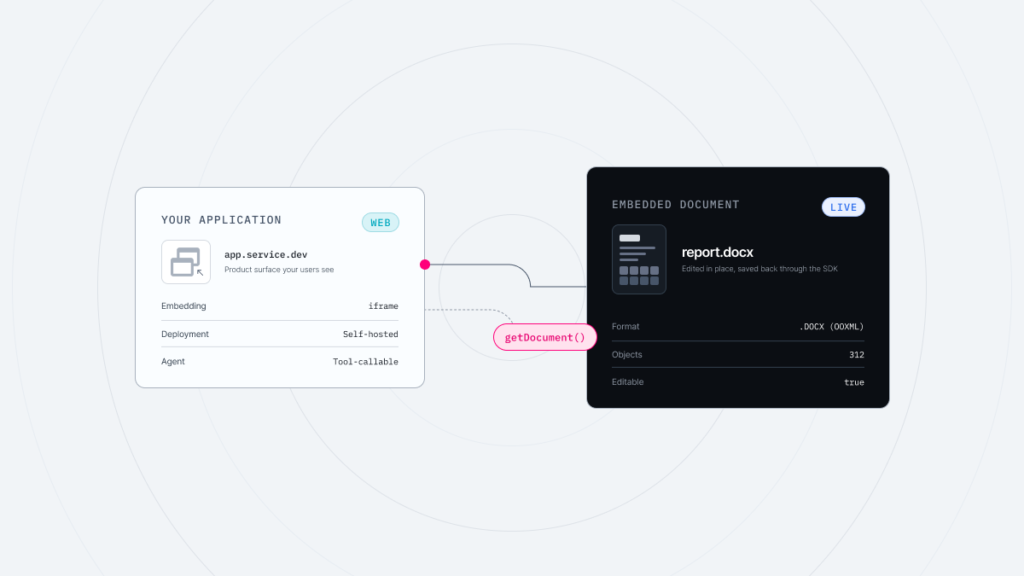
Thinkfree Office is now offered as Thinkfree Document Editor SDK for embedded document editing, object-level APIs, and AI agent integration.
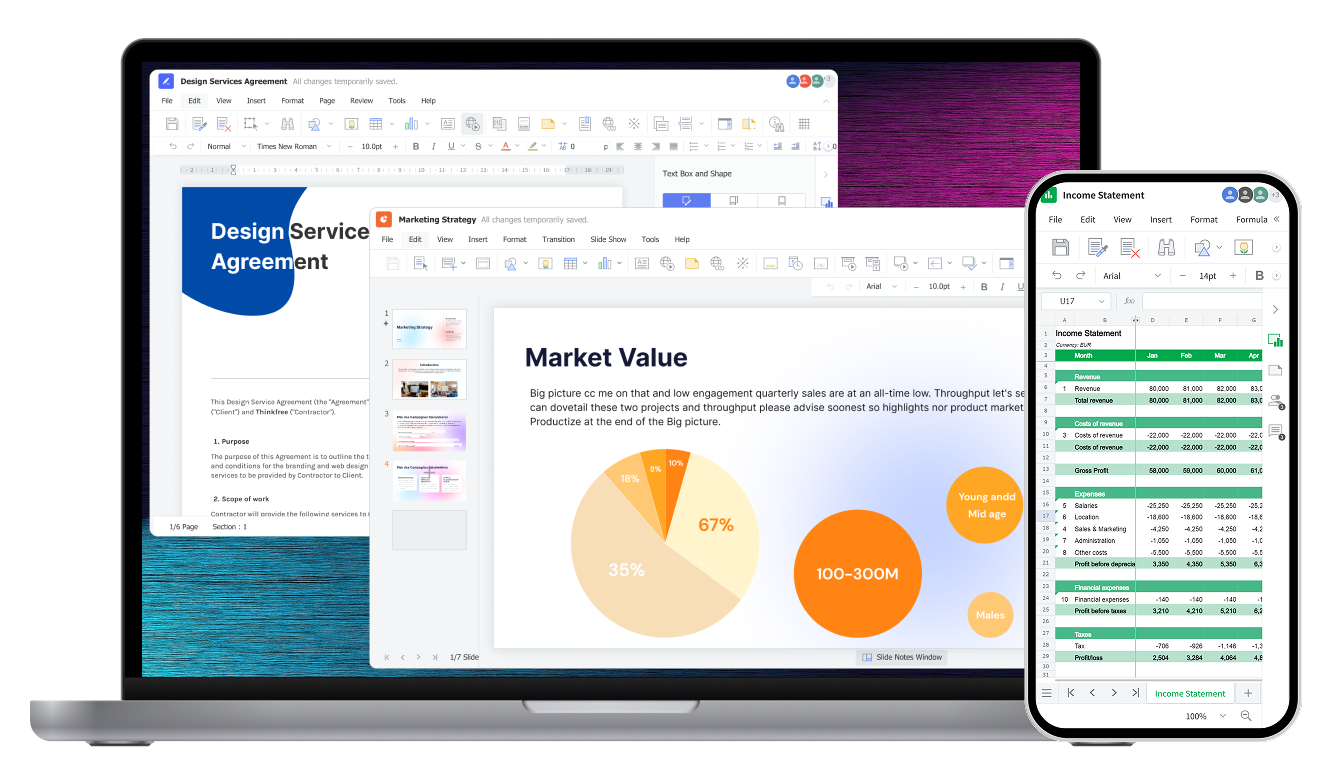
Several solutions including Collabora Online, LibreOffice Online, and ONLYOFFICE claim ODF compatibility. Thinkfree Office differentiates itself through the depth of that implementation, especially when compared to other market alternatives. Thinkfree Office treats ODF standard properties as fully editable elements rather than display-only artifacts, ensuring business continuity in complex document environments.
This is especially evident with high-complexity elements like 3D and surface charts. Thinkfree Office uses a built-in full-model chart engine that renders and edits ODF properties such as view3D, serAX, and bandFmts natively. This technology guarantees data integrity during chart recalculations.
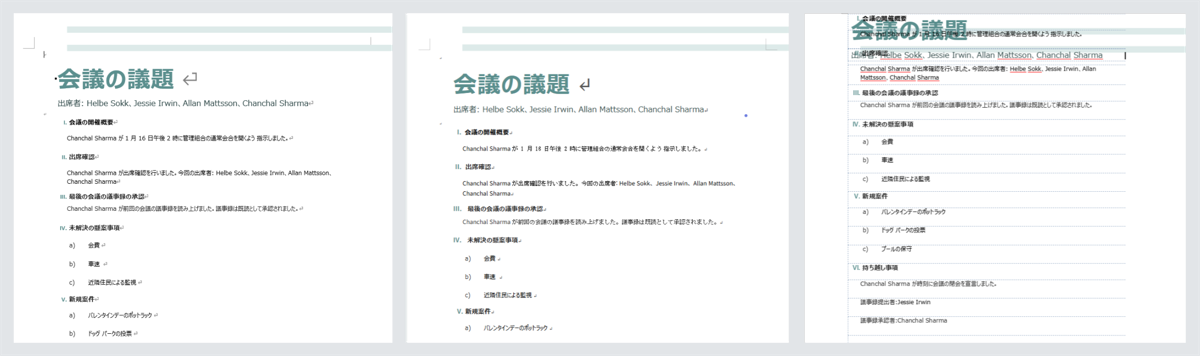
Furthermore, Thinkfree Office applies strict preservation principles for OLE objects, layouts, and formulas across ODT, ODP, and ODS. This means files are not just readable but fully editable and reusable in practice. With support for on-premises online office deployment, private cloud, and hosted API environments, Thinkfree Office integrates flexibly with existing enterprise infrastructure.
Challenge | Thinkfree Office |
|---|---|
Corruption of 3D/Surface Charts | Renders and edits ODF standard properties (view3D, serAX, etc.) natively. |
Data Reference Errors | Guarantees data integrity during chart recalculations and layout shifts. |
Object and Layout Breakage | Maintains original objects, formulas, and OLE elements across all ODF types. |
Compatible Limitations | Full support for on-premises, private cloud, and hosted API environments. |
Scalability Issues | Easy deployment and scaling via Docker and Kubernetes. |
Given how long it takes to transition enterprise document environments, 2028 is closer than it appears. Without a thorough review now, organizations may find themselves without viable options, facing a scramble driven by timeline and budget constraints rather than technical merit.
The ODF mandate started in the public sector, but it ultimately reshapes how all organizations manage documents and preserve data. Adopting an online office that supports ODF today allows you to respond immediately to procurement changes, reduce conversion costs, and ensure the interoperability required by global markets.
Thinkfree Office offers a realistic path for organizations that must maintain existing OOXML workflows while securing long-term data independence through ODF. When format independence and business continuity go hand in hand, ODF compatibility is no longer optional. It is a core requirement.
Yes. The March 2026 resolution applies to federal, state, and local government bodies in Germany. However, private organizations that work with public institutions, participate in public procurement, or support government projects may also benefit from ODF-compatible workflows as interoperability requirements become more common.
No. Many office applications can open ODF documents, but they may not preserve all document features. Advanced elements such as embedded objects, complex charts, formulas, or formatting can be affected. Full ODF support means these elements remain intact and editable throughout the document lifecycle.
No. Many organizations use both formats depending on their workflows. Thinkfree Office provides native support for both OOXML and ODF, allowing teams to continue collaborating in DOCX while using ODF for long-term archiving, interoperability, or public-sector requirements.
The resolution establishes a policy direction rather than introducing immediate legal penalties. It encourages public institutions to move toward ODF adoption, with Germany targeting ODF-ready federal IT infrastructure by 2028. Organizations that expect to work with the public sector may choose to prepare earlier to simplify future compliance and document exchange.
Germany’s policy emphasizes open standards rather than vendor-specific formats. ODF is an internationally standardized document format designed to improve interoperability, long-term accessibility, and vendor independence across public-sector systems.
Yes. ODF is published as ISO/IEC 26300, an international standard for editable office documents. Because it is openly standardized, organizations can exchange and preserve documents without depending on a single software vendor.
Like this post? Share with others!