
AI can draft a contract, but a document engine still needs to handle review, redlining, and format-preserving export before it becomes business-ready. This article explains why CLM platforms fail after AI drafting, and what a legaltech document layer needs to solve: format fidelity, reviewability, and audit trails.
The legaltech market in 2026 is being reshaped around agentic AI. Major players including Thomson Reuters, LexisNexis, and Harvey have introduced agentic AI based capabilities in the first half of 2026. This points to a broader move toward agentic automation across the legal industry.
Unlike traditional generative AI, which mainly returns answers to questions, agentic AI can plan and execute multi step workflows on its own. Tasks that legal teams handled manually, from drafting contract language to proposing redlines and tracking obligations, are moving into AI driven workflows.
At the same time, this raises an important question. As AI generates contracts faster, the question becomes whether the environments where humans review, validate, and approve those outputs are evolving at the same pace.
As Agentic AI advances, the human role shifts from drafting documents to verifying and approving AI-generated outputs. When AI drafts contracts based on various clauses and precedents, users do not need features to rewrite documents from scratch. Instead, they require a reliable review environment to track AI-driven changes, ensure governance compliance, and make final decisions.
Human-in-the-loop workflows are no longer an extension of manual editing. They are a design requirement for completing contract workflows in the agentic AI era.
Furthermore, finalizing legal documents still depends on review and sign-off by lawyers, contract managers, and procurement professionals. As demand for AI governance grows, the importance of document history, audit trails, and version control also increases. In the end, expectations for the product experience rise sharply the moment an AI-generated output reaches the user.
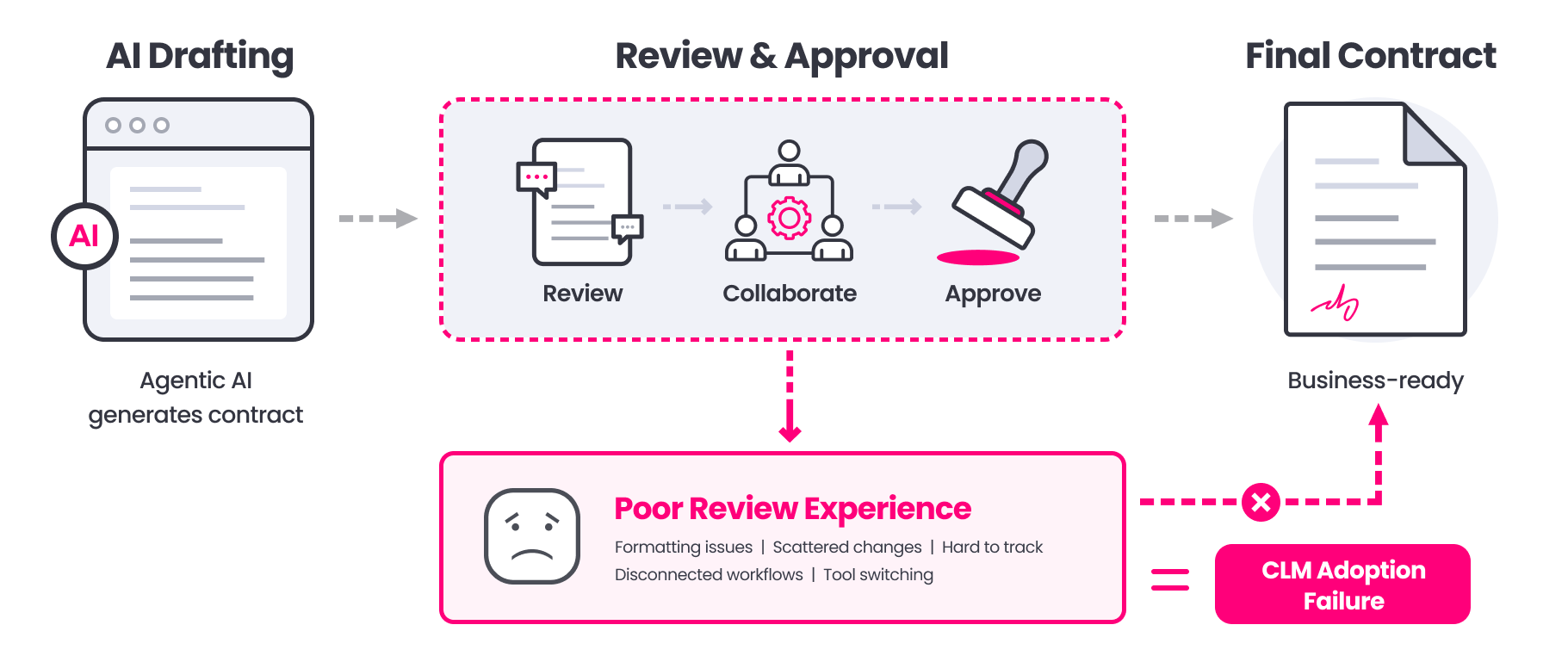
This is also where users form their impression of the product. If formatting breaks or the interface feels awkward when the AI output hits the editor screen, users immediately leave for external tools. The failure is not caused by AI itself, but by the lack of a well designed experience for handling documents in real work.
Real-world customer feedback points in the same direction. G2 often highlights criteria such as Best Usability, Easiest Admin, Best Meets Requirements, and Easiest to Use for contract lifecycle management (CLM) products. The legaltech community also emphasizes the importance of simpler user experiences, data sharing across teams, and alignment with real workflows. Meanwhile, one General Counsel anonymously shared that legal professionals spent more time resolving issues a year after CLM implementation. This GC explained that the real bottlenecks lay in review tasks like redlining, internal escalations, and streamlining negotiation rounds.
In practice, adopters rarely ask whether a CLM has enough features. They are asking whether their teams can actually use it in day to day work. Instead of assessing AI performance itself, the real issue here is the day-to-day user experience.
“(…) The success of a CLM program does not boil down to selecting a high‑performing technology solution. It primarily depends on a nuanced understanding of each organization’s specific challenges, strong alignment among stakeholders, and rigorous, fit‑for‑purpose project management over time.”
CLM failures rarely stem from a single cause. They usually involve both organizational and process issues. However, users encounter these issues directly in their daily product experience. In particular, the document experience during contract review and approval becomes the intersection where organizational bottlenecks materialize.
For legaltech platform builders, this is an area that can be improved directly. It also determines how users perceive the core issues leading to CLM adoption failure. These challenges typically appear in the following areas.
Deloitte pointed to complex stakeholder collaboration as a major challenge in contract management. Contracts are, by nature, outputs created by multiple departments together. However, many CLM solutions are tailored primarily to legal workflows, creating a disjointed experience for other departments trying to review and edit documents.
While the entire lifecycle from creation to execution relies on collaboration, different departments have distinct needs. Legal teams focus on control and version tracking, procurement requires separate approval paths, and finance seeks ERP integration. Meanwhile, sales and operations teams often expect visibility into contract status from familiar environments such as Microsoft Word. If a CLM is not designed as a collaborative infrastructure, it will eventually be reduced to a tool used only by the legal team.
Integration with existing systems is a major concern during CLM implementation. According to Deloitte, integration issues along with implementation complexity and duration ranked as the second and third top concerns when selecting a CLM. If the document editing experience is disconnected from existing tools, users will leave the platform at the very moment they need to review and revise contract content.
In this case, users first notice integration problems in the way they handle documents, not at the system level. When contract data and decision context scatter across multiple systems, the consistency of the CLM workflow weakens. Review and revision done outside the platform do more than create user inconvenience. They also create data fragmentation and make it harder for the organization to maintain visibility across the entire contract process. As a result, the operational efficiency and governance improvements expected from CLM adoption can be limited. This is why documents are more than deliverables. Within legal document management software, they are part of the operational workflow.
Users tend to choose familiar workflows over more powerful functionality. If the document editing method differs greatly from the word processor experience they already know, they face a heavy learning burden during the core tasks of review and revision. If formatting breaks or the editing flow feels unfamiliar, users will simply abandon the product.
Trying to solve this problem only through onboarding training can lead to greater long term resource loss and risk. If the editing environment users touch every day does not feel natural and familiar, the product will not become part of the actual workflow.
While Agentic AI automates various tasks in the legal field, generating a document and turning it into a business-ready deliverable are two different challenges. For that reason, the following issues that appear after a document is generated must also be considered.
Clause structure, numbering, tables, footnotes, and revision history all play a role in the contract review process. Small issues such as line breaks, broken tables, indentation errors, or font inconsistency can reduce the credibility of a legal document. If AI-generated output conflicts with the existing document structure or breaks formatting consistency, users must reorganize the document before they can review the content. Over time, this leads to wasted organizational resources.
As AI-generated documents increase, the extent to which they can be easily reviewed, edited, and approved becomes one of the most important measures of value in an AI-enabled CLM environment. A contract is not an immediate final product. Instead, it is a collaborative output finalized through meticulous review and negotiation among lawyers and various internal stakeholders.
As AI adoption expands, clauses and faulty references caused by hallucinations continue to be reported, creating additional governance requirements for legal document management software. It is a major legal risk, not just a simple error. As the use of AI widens, demand also grows for systems that can track revision history, approval steps, and responsible parties. Legaltech platforms should therefore aim not only to embed AI, but also to build an environment that can safely manage AI generated outputs.
According to a Deloitte research from last year, 73% of respondents expected core CLM capabilities to include contract creation, management, execution, and tracking. Meanwhile, 64% look for revision management, negotiation, and approval functionalities. Respondents also noted redline summarization and automated drafting as top areas for expected AI utility. These findings strongly support the importance of improving the document experience within CLM solutions.
End-users interact far more frequently with the word processor screen than with the underlying AI engine. Even so, many CLM solutions still rely on external tools or provide only limited document functionality inside the product. This weakens end user UX consistency. As AI becomes more prominent in legaltech, users will judge platforms less by the number of AI features and more by how easily they can review and finalize contracts without leaving the workflow.
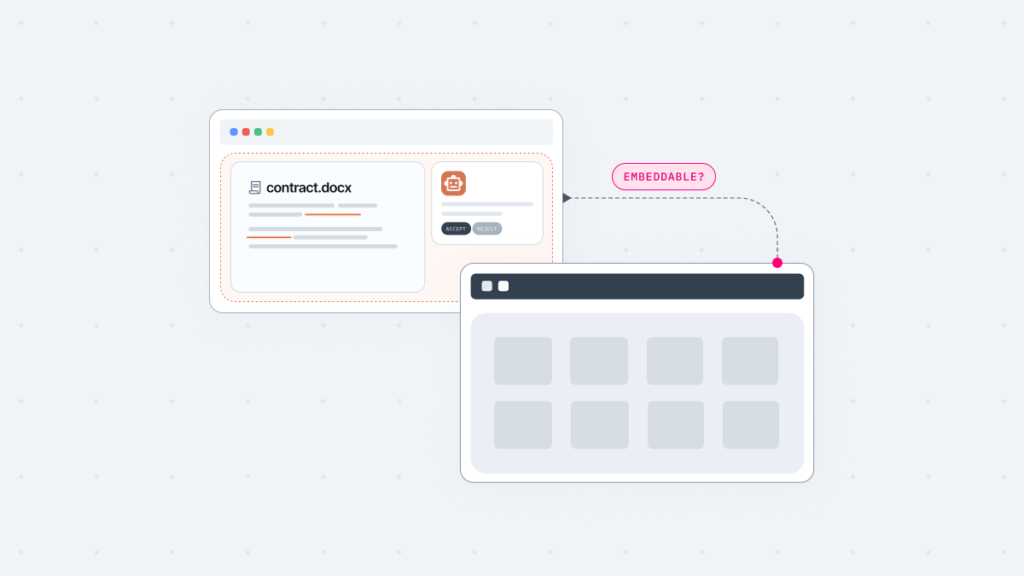
To prevent users from moving to external tools, the in-platform editing experience must feel familiar and intuitive during contract review and revision. If a CLM product provides AI based document features, the AI-generated output should preserve the intended formatting and be completed as a document without disruption. At the same time, keeping users inside the platform to edit and finalize those documents helps reduce user attrition.


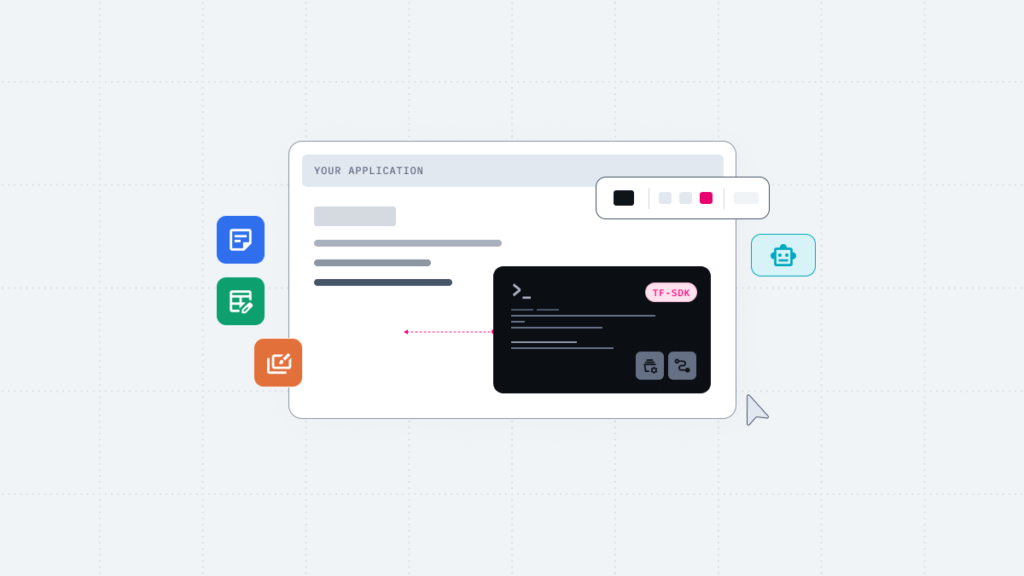
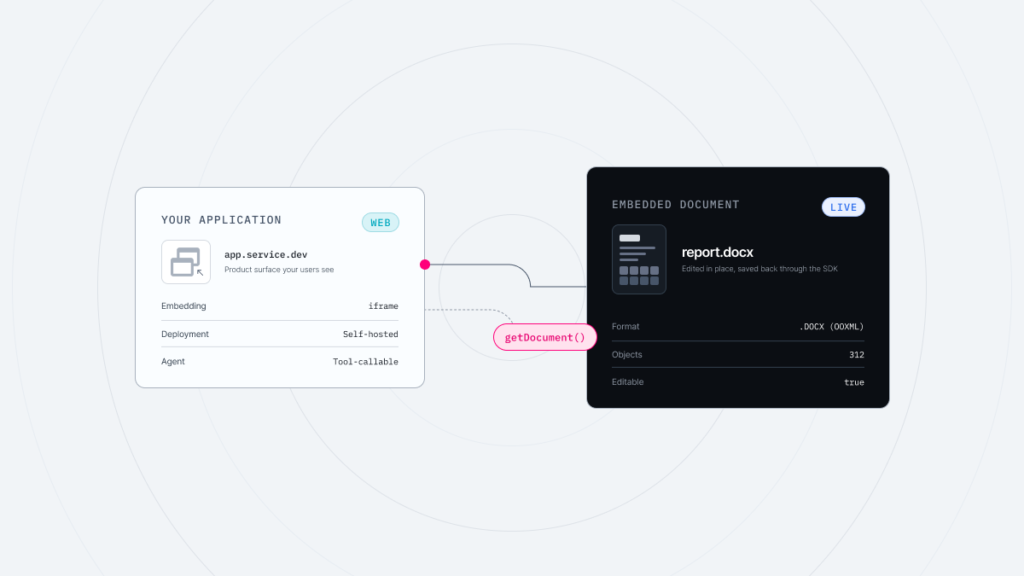
Thinkfree Document Editor SDK is an office editing layer designed to address gaps in the document experience within legal document management software and CLM platforms. It helps bring document review and finalization into the legaltech product, allowing generated text to be refined into production-ready documents.
It supports .docx and .odt and processes AI generated output while maintaining the structure of legal documents.
By supporting AI functions such as clause insertion, draft generation, and data review together with the editing layer, it provides a seamless document experience for review, approval, and version management inside the product. It can also be integrated naturally into a company’s brand through a white label approach.
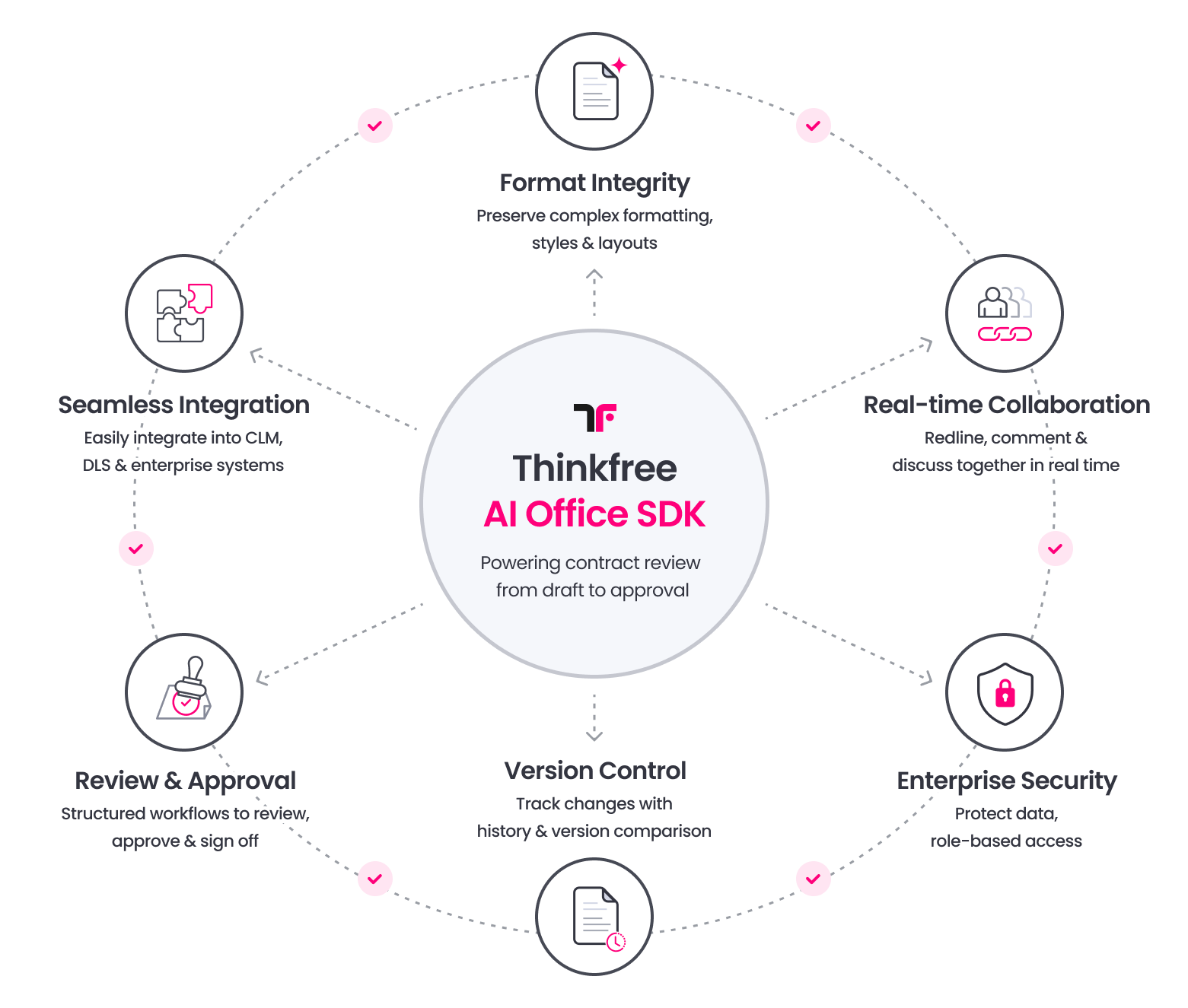
For legaltech builders, improving the document experience while preserving the existing CLM architecture is crucial. Thinkfree Document Editor SDK can be embedded into existing CLM architectures without requiring major changes. It integrates flexibly regardless of the LLM or sLLM powering your AI infrastructure.
It provides an interface that users familiar with existing word processors can use right away without separate training. As a web based tool, it also supports multi user simultaneous editing, collaboration, and comments.
Agentic AI is becoming a standard part of legaltech products. AI can now generate contracts, but finalizing them remains a human responsibility. The quality of the CLM platform they build will also depend on how generated documents are handled.
For legaltech platform builders in 2026, the real question is no longer which AI model to adopt. The core challenge is designing an environment where AI-generated outputs reach the user in a way that feels familiar, secure, and convenient.
Learn more below.
CLM implementations often struggle when organizations focus primarily on workflow automation while overlooking the document experience. Contract creation, negotiation, review, and approval still depend on efficient document editing and collaboration, making user adoption just as important as automation.
No. AI can accelerate contract drafting, clause analysis, and information extraction, but legal and business teams still need to review, edit, negotiate, and approve contracts. Successful CLM implementations combine AI with robust document editing and human oversight.
Yes. Many organizations enhance existing CLM platforms by embedding document editing and AI capabilities instead of replacing their current systems. Thinkfree Document Editor SDK is designed to integrate with existing architectures, helping organizations modernize contract workflows while protecting previous technology investments.
Contracts are living documents that go through multiple rounds of drafting, negotiation, redlining, and approval. Embedded document editing keeps these activities within the CLM platform, reducing context switching while improving collaboration and document governance. Thinkfree Document Editor SDK combines enterprise-grade document editing with AI-powered drafting to support these end-to-end workflows.
Like this post? Share with others!