
Enterprise AI has entered a new phase. Over the past several years, organizations have focused on questions surrounding data sovereignty. Where is our data stored? Who controls it? Can we deploy AI without compromising security, compliance, or governance?
These questions have fundamentally shaped enterprise AI adoption, and they remain essential, particularly for organizations operating in regulated industries or managing sensitive information. But as AI moves from helping people to doing the work itself, a new question matters more.
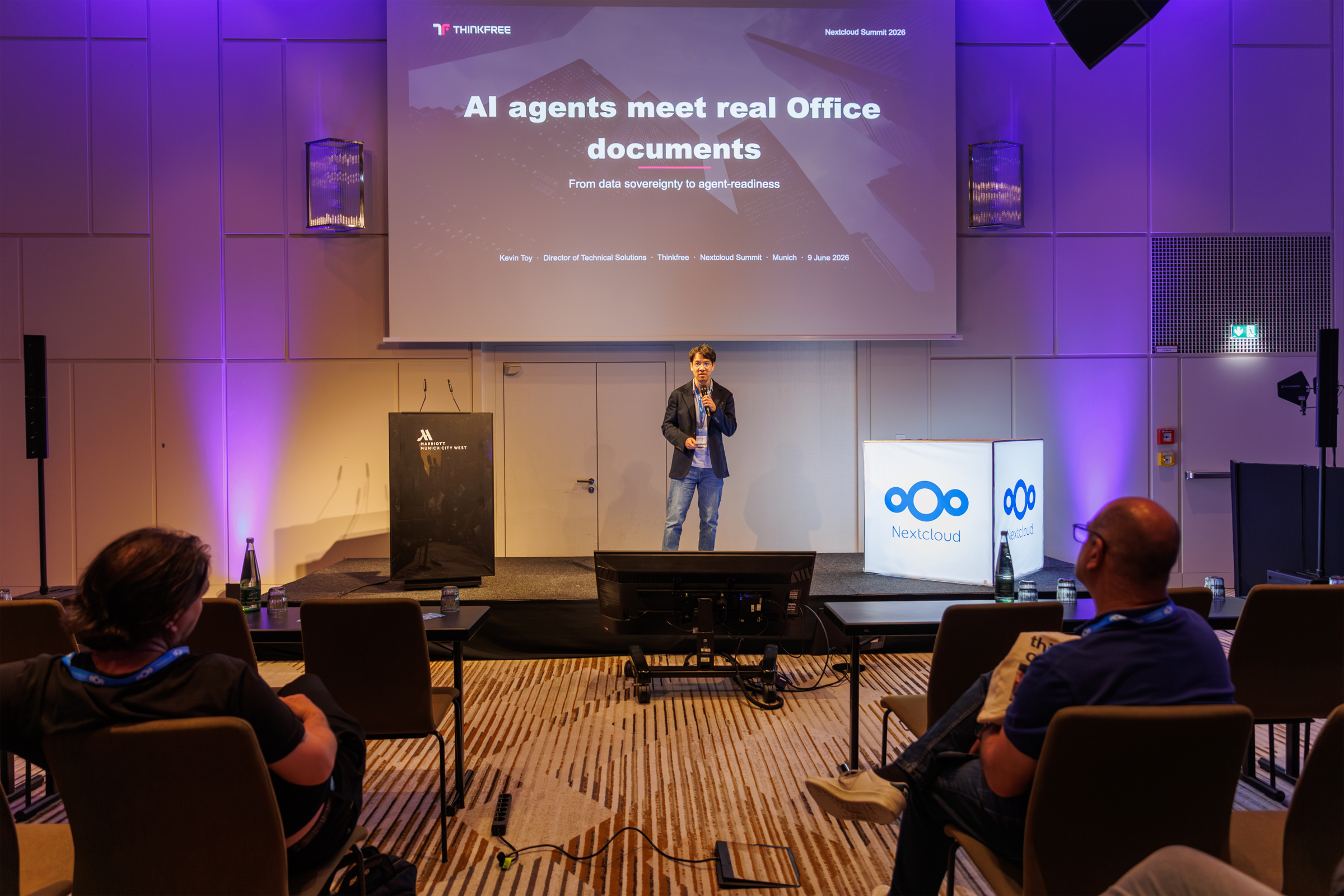
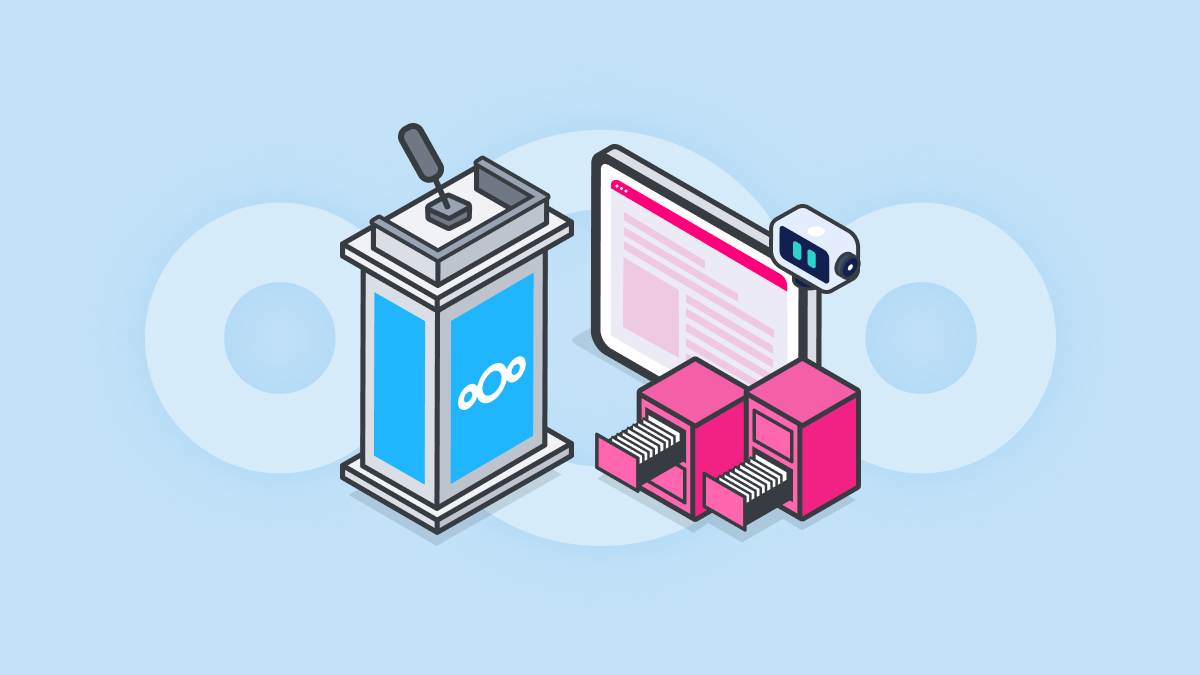
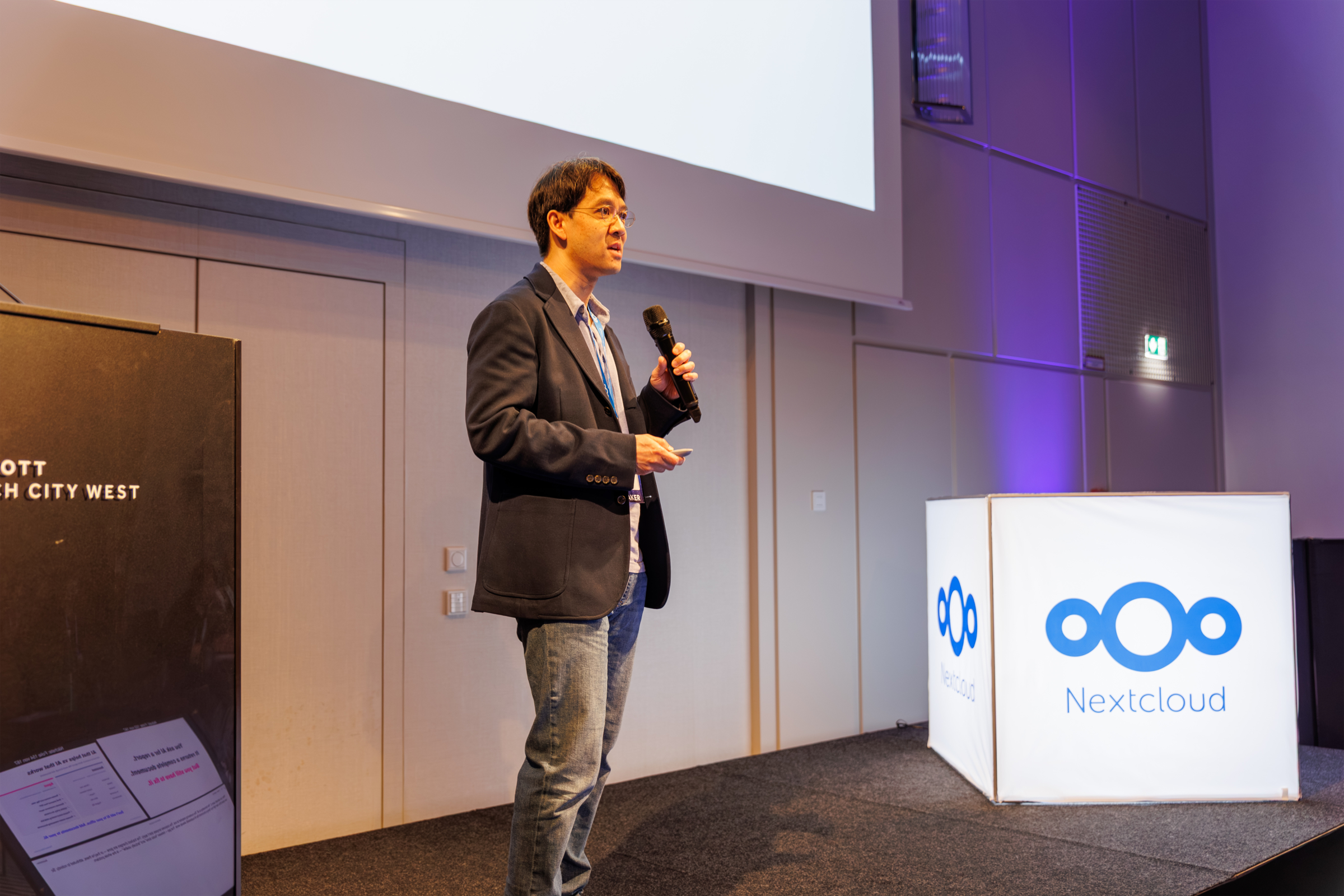
At Nextcloud Summit 2026 in Munich, Thinkfree’s Director of Technical Solutions, Kevin Toy, posed that question to the Nextcloud community during a session centered on data sovereignty. His framing was direct: “Sovereignty is already your answer. So what is the next question?”
This article explores why agent-readiness is becoming the next challenge for enterprise AI and why meeting that challenge requires a new kind of document infrastructure: an AI document platform. The discussion also builds on Thinkfree’s broader work with organizations adopting sovereign collaboration platforms such as Nextcloud. Through its partnership with Nextcloud, Thinkfree provides an Office solution that integrates with the platform.
Today’s AI models can generate reports, summarize complex documents, draft proposals, review contracts, and create presentations with remarkable fluency. Yet in many organizations, the handoff from generated content to a usable document still takes human cleanup.
AI generates the content, but people still prepare the document for actual business use. Formatting is restored. Templates are reapplied. Tables are rebuilt. Comments and tracked changes are recreated. The document is reviewed again before it can be shared. The bottleneck is no longer the model. It is the workflow around the document.
For years, enterprise document systems were designed around people creating and editing documents. AI changes that assumption. When software begins performing work rather than simply assisting users, document infrastructure must evolve as well.
The more useful distinction is between AI that helps and AI that executes.
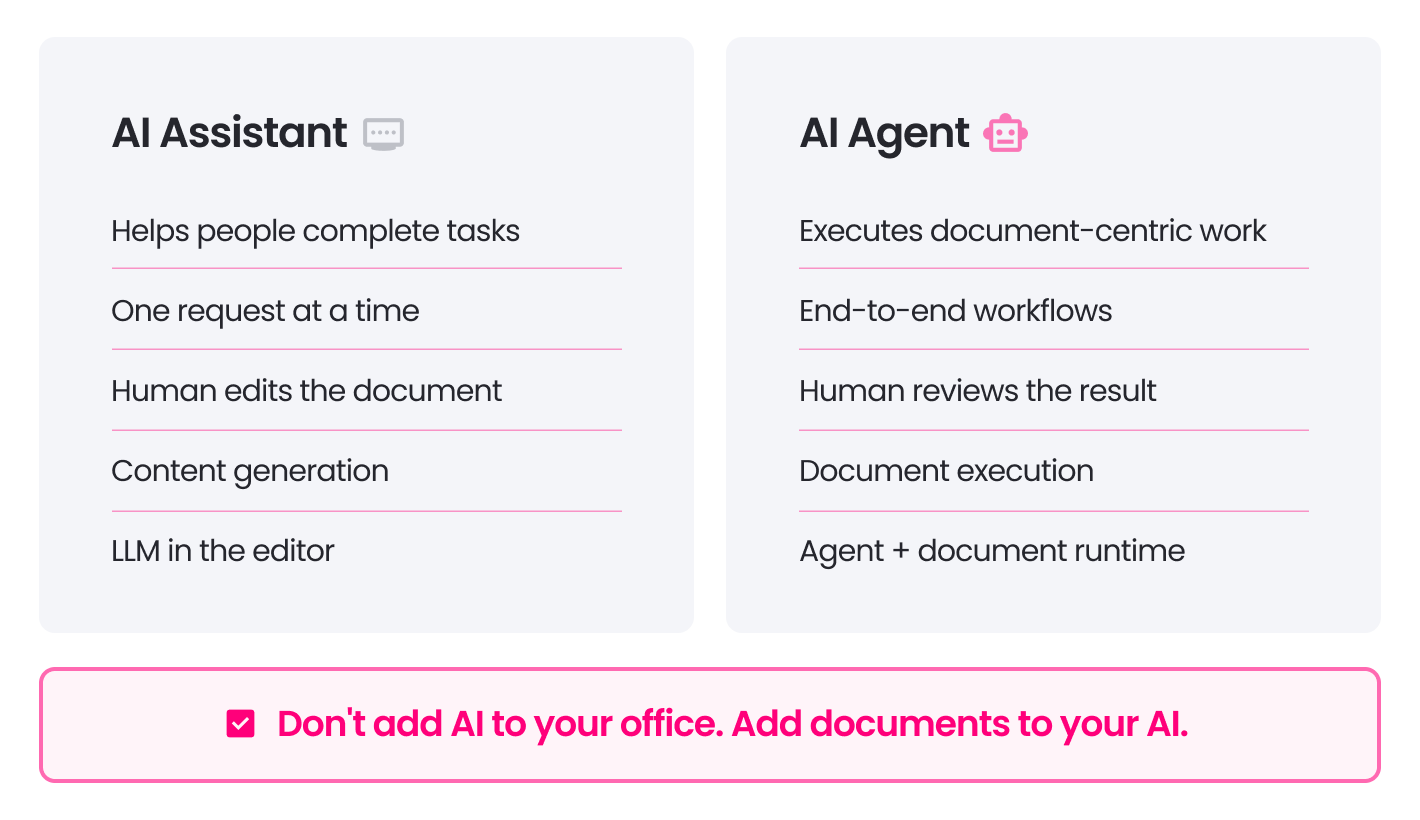
An assistant helps people complete individual tasks. It summarizes content, rewrites paragraphs, translates text, or suggests improvements while the user remains responsible for completing the work.
An agent goes a step further. It can execute business processes end to end. Rather than generating isolated content, it can review a contract against internal policies, draft a proposal from an inbound RFP, generate a recurring compliance report, update policy documents, or assemble board materials using enterprise knowledge. People remain responsible for oversight, approval, and collaboration, rather than reconstructing the document afterward.
That shift is why Thinkfree framed its core proposition in Munich as follows: “Don’t add AI to your office. Add documents to your AI.”
This pattern becomes clearer in three common workflows. In sales, an agent can read an inbound RFP, retrieve relevant internal knowledge, and draft a response using the organization’s approved Word template. Legal teams have agents draft against a playbook, apply redlines, and track changes across multiple review rounds. Dozens of reviews can run in parallel. Finance teams have agents pull data on a schedule and generate Word, Excel, and PowerPoint deliverables on a weekly, monthly, or quarterly cadence.
Each scenario depends on the same condition: the work has to happen inside a real Office document, with structure and formatting intact.
That requirement exposes a simple limitation in most AI document workflows today. Most approaches fall into one of three patterns. Some convert Office documents into plain text, Markdown, or HTML before sending them to an AI model. Others regenerate an entirely new document after AI processing. Some extract selected content, modify it separately, and put it back into the file. Each approach solves part of the problem. All of them share the same limitation: they reduce Office documents to text.
Enterprise documents are not simply collections of words. They contain document structure, formatting, tracked changes, comments, references, templates, page layouts, tables, charts, metadata, and business rules that carry operational meaning. Those elements support collaboration, governance, compliance, and organizational consistency. When documents are flattened into text, much of that context disappears. Headings, fonts, margins, numbering, charts, comments, images, headers, footers, and tables of contents are all lost.
The result may be acceptable for generating content. It is rarely sufficient for executing enterprise work.
As organizations adopt AI agents, the conversation naturally shifts from content generation to execution.
Other categories of AI agents already rely on execution environments. Coding agents generate code that a runtime, such as a sandbox or interpreter, executes directly. Browser agents perform actions through a browser layer capable of interacting with web applications.
Document workflows rarely have an equivalent execution layer. Instead, AI generates content while people reconstruct the final Office document manually.
This is where agent-readiness comes in. It is the ability of an organization’s document infrastructure to allow AI agents to execute document-centric work safely, reliably, and repeatedly while preserving document fidelity.
Agent-readiness is not a characteristic of the language model. Instead, it reflects the infrastructure surrounding it. Without an execution layer designed for documents, even the most capable AI model remains limited to assisting people rather than completing work.
Preparing enterprise systems for AI agents requires a different architectural approach. Reasoning and execution should no longer sit in the same layer. The AI agent determines what needs to happen. An agent layer manages planning, permissions, tool schemas, and orchestration. A document runtime executes those operations directly on native Office documents.
Thinkfree approached the problem differently by building the execution layer that document agents need. The same architecture formed the foundation of Thinkfree’s session in Munich and is now implemented in Thinkfree AI Office SDK.
The SDK combines a native OOXML and ODF document runtime with a web office editor, integrates with an organization’s existing AI models, and allows users to work with AI and Office documents in a single screen through a built-in AI Chat UI.
During the live demonstration, a command such as “Insert a comparison table in section 3” was validated and executed directly on the OOXML document. As a result, the runtime updated the document in place while preserving its fidelity.
Beyond native editing, the SDK also includes capabilities such as sensitive data masking, document validation and recovery, token-efficient section-level editing, and flexible deployment options. Organizations can deploy it on-premises, in a customer-controlled cloud, or in air-gapped environments without allowing data to leave their infrastructure. The SDK can also integrate with collaboration platforms such as Nextcloud, allowing organizations to add AI-powered document workflows without disrupting their existing document management environment. For a community built around data sovereignty, that was the baseline. Agent-readiness was the next layer.
Deployment option | Typical use case | Data crosses customer boundary? |
|---|---|---|
Self-hosted on-prem | Nextcloud-style sovereignty, regulated industries | No |
Customer-controlled cloud | Enterprises with private-cloud mandate | No — stays in their account |
Air-gapped | Defense, classified, sensitive government | No — zero external dependencies |
Building a production-grade OOXML engine takes serious engineering effort. Some organizations have invested years developing this capability internally. Thinkfree AI Office SDK can typically be integrated in days rather than months, freeing teams to focus on the domain logic that actually differentiates their AI solutions rather than the document layer underneath it.
Once documents become executable environments rather than static files, organizations can automate document-centric workflows without compromising quality or control.
Sales teams can generate multi-section proposals while preserving templates, headers, page numbering, and document structure. Legal teams get tracked changes with author attribution, comment threads that can be inserted and resolved, and stable cross-references across numbered clauses. Finance teams get cross-document data binding across Word, Excel, and PowerPoint, with formulas, conditional formatting, and consistent slide layouts carried through scheduled, headless execution.
RFP responses, contract reviews, and finance reports look different on the surface. Underneath, they run on the same runtime and the same tool-calling pattern.
Data sovereignty transformed how organizations evaluate enterprise AI. It established trust, governance, and control as fundamental requirements for adoption.
As AI agents become part of everyday enterprise workflows, another requirement is emerging: document infrastructure designed not only for human collaboration, but for AI execution. Agent-readiness is the capability that allows AI agents to move beyond generating content and begin executing meaningful work on enterprise documents while preserving the integrity those documents require.
The next era of enterprise AI will depend on more than better models. It will also be defined by whether enterprise documents are ready for those models to work.
Let’s return to the question raised in Munich. If your organization has already established data sovereignty, the next question follows naturally: are your documents, and the infrastructure behind them, ready for AI agents to do the work? If your organization is exploring how to prepare document-centric workflows for AI agents, take a closer look at Thinkfree AI Office SDK.
This article is based on the session “AI Agents Meet Real Office Documents: From Data Sovereignty to Agent-Readiness,” presented by Kevin Toy, Director of Technical Solutions at Thinkfree, at Nextcloud Summit 2026 in Munich, Germany, on June 9, 2026.
Discuss your requirements with our team.
See how it works in your product.
Like this post? Share with others!