
Thinkfree Office is now offered as Thinkfree Document Editor SDK for embedded document editing, object-level APIs, and AI agent integration.
As enterprises adopt LLMs and sLLMs, users increasingly expect AI capabilities to work directly within the documents they create and edit. However, many AI tools generate content outside the document environment, forcing users to move between chat interfaces and document editors.
Thinkfree Office is an AI-embedded online office suite for enterprises that enables organizations to deploy secure document editing environments across on-premise, private cloud, or hosted infrastructures. Through SDK-based integration, organizations can integrate document editing capabilities into their applications, connect their preferred AI models, and build AI-powered document workflows. This enables software vendors and enterprises to deliver AI-assisted document experiences while maintaining control over deployment, security, and governance requirements.
Unlike standalone AI tools, Thinkfree Office is a deployable enterprise office platform that brings AI integration capabilities directly into a full-featured document editing environment, allowing organizations to connect their preferred LLMs and sLLMs without building or maintaining a custom web office engine. It enables users to generate, edit, and refine documents through natural language commands directly within the editor. As a result, users can stay within a single workspace instead of switching between AI tools and document applications.
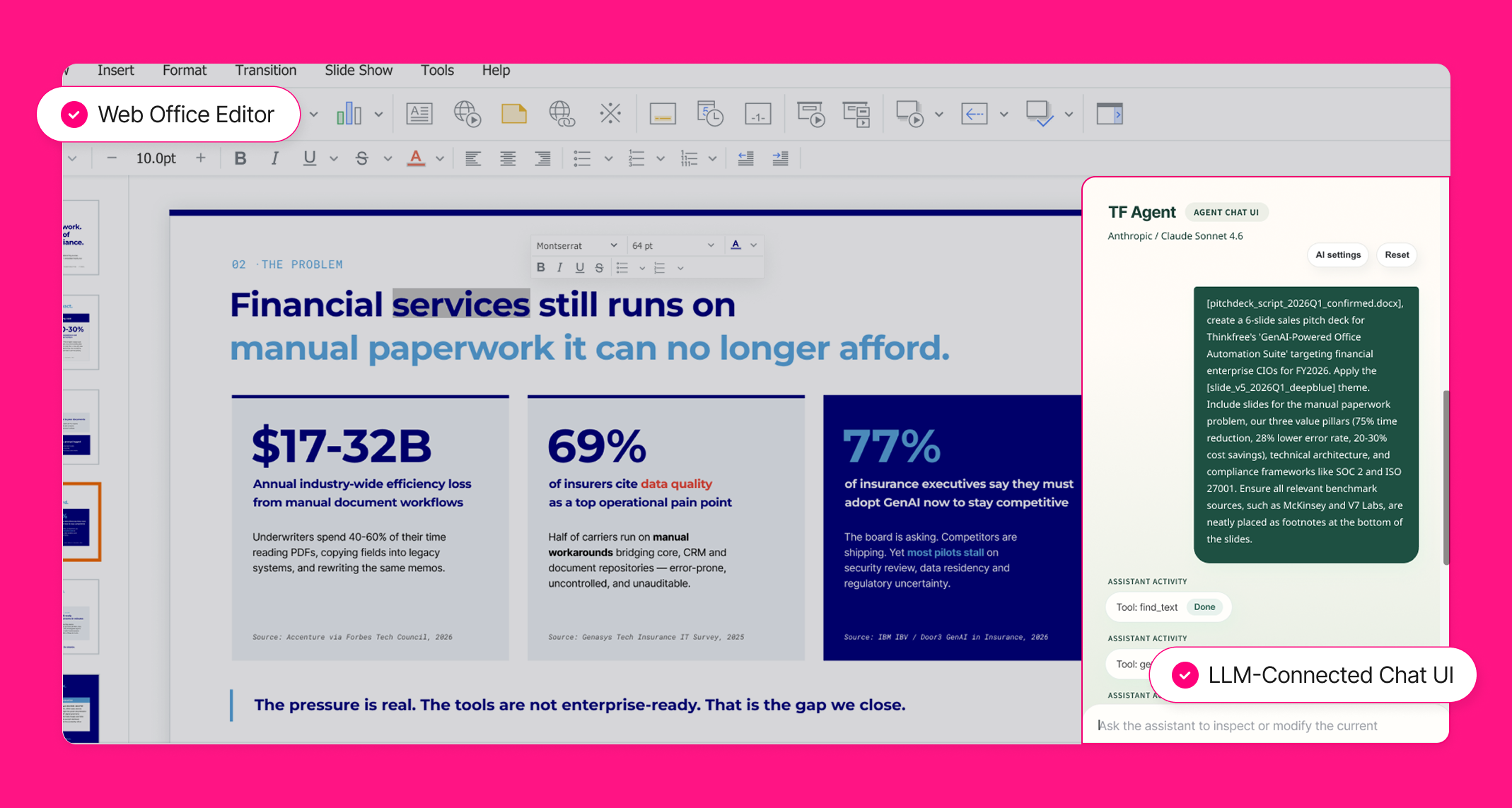
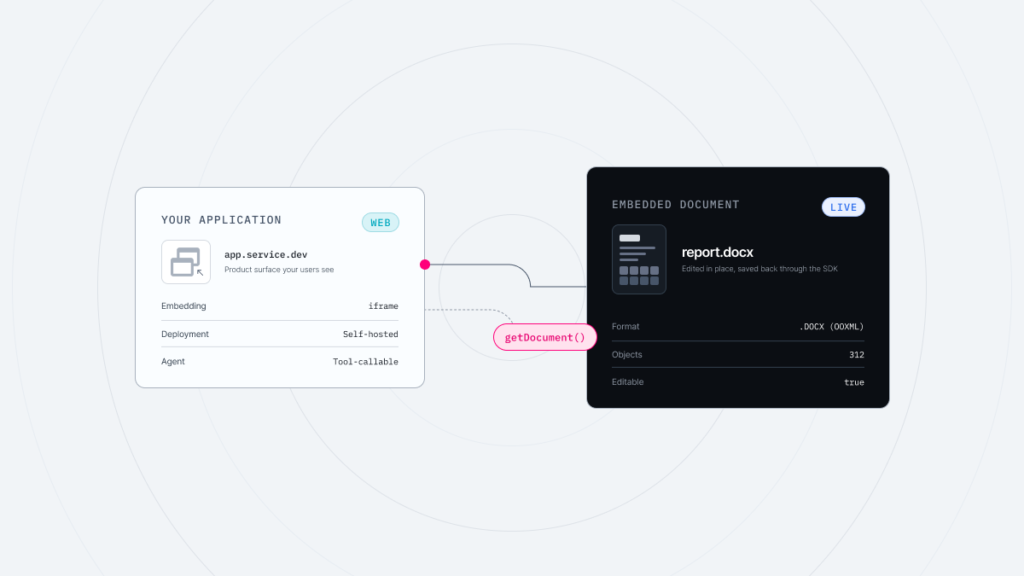
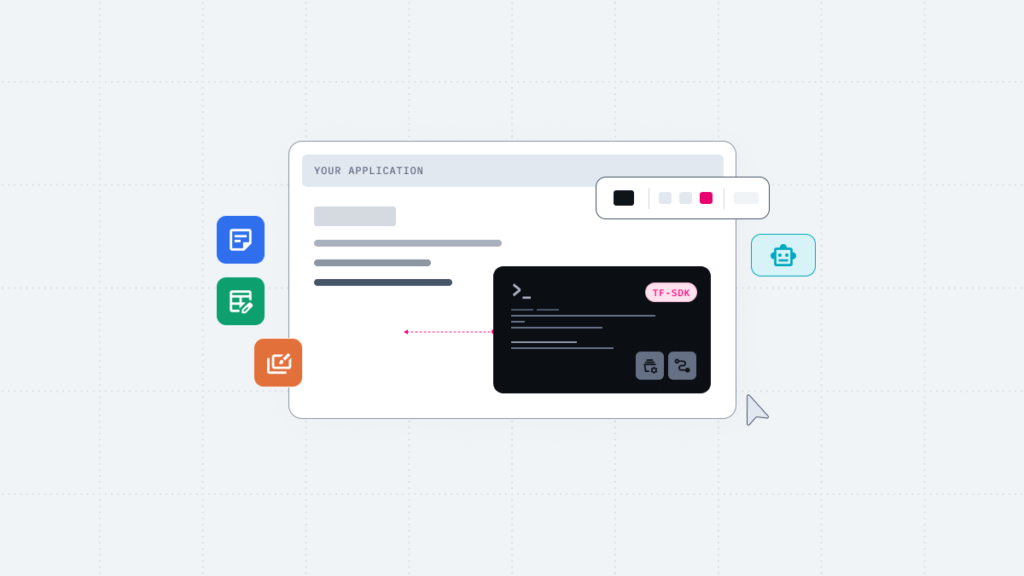
Instead of generating isolated text outputs, Thinkfree Office enables users to create, edit, and manage structured documents within a web-based office environment. The experience fits naturally into existing business workflows. As a SDK, it can be integrated into a wide range of enterprise environments and deployed in multiple ways, including on-premise, private cloud, and hosted API.
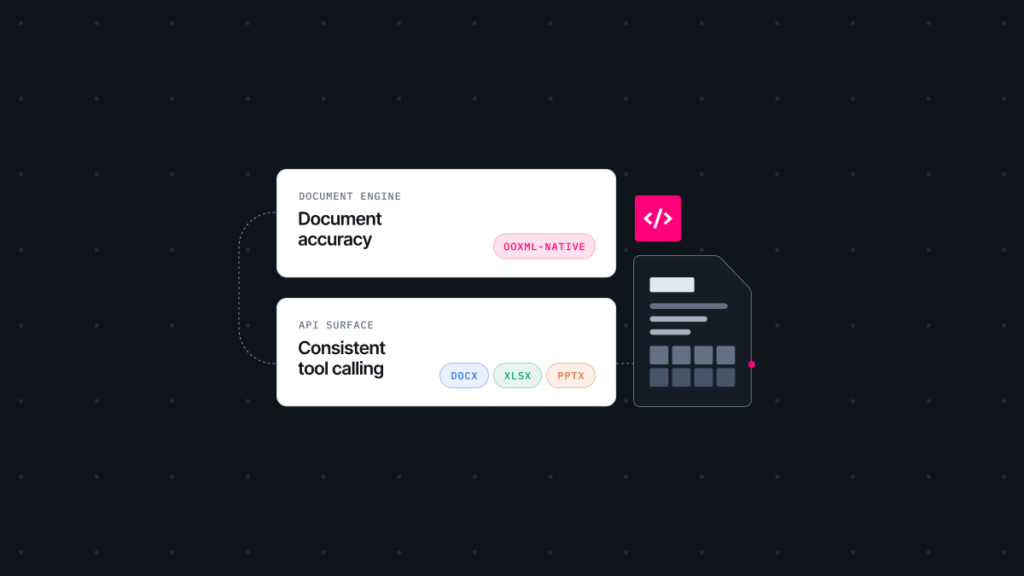
Thinkfree Office combines three core capabilities in a single platform:
This allows organizations to implement AI-enabled document workflows without building or maintaining a proprietary web office engine or document editing environment.
Many organizations consider building their own AI-powered document processing systems. In practice, however, these projects often involve higher development costs and operational burdens than expected.
Building an AI-enabled document platform requires far more than connecting an LLM to a user interface. Organizations often need document editing capabilities, rendering engines, format compatibility layers, security controls, and integration frameworks. Maintaining these components over time can significantly increase development costs and extend project timelines.
While generating text with an LLM is relatively straightforward, preserving document fidelity across formats such as OOXML and ODF is far more complex. Supporting tables, images, styles, page layouts, and collaboration features requires significant engineering effort. It also requires ongoing maintenance.
Organizations that depend on a single LLM may struggle to adapt to future model changes or pricing structures. To maintain long-term flexibility and cost efficiency, enterprises increasingly need architectures that support multiple LLMs and sLLMs.
Many AI services deliver output as plain text. Users must then move the generated content into a document and continue editing manually. This creates friction in everyday workflows and can reduce the practical value of AI adoption.
Solutions such as Microsoft 365 Copilot provide powerful capabilities. However, organizations that need to embed AI document functionality into their own products or maintain direct control over infrastructure, deployment, and data governance may require a different approach.
Learn More: Microsoft 365 Copilot Alternative for Enterprise
Its native OOXML and ODF engine enables accurate document parsing and rendering. Thinkfree Office helps preserve document layouts and formatting across Microsoft Office and ODF-based environments. It supports formats such as .docx, .pptx, .xlsx, .odt, .odp, and .ods. This helps reduce development effort while minimizing formatting issues that can disrupt business workflows.
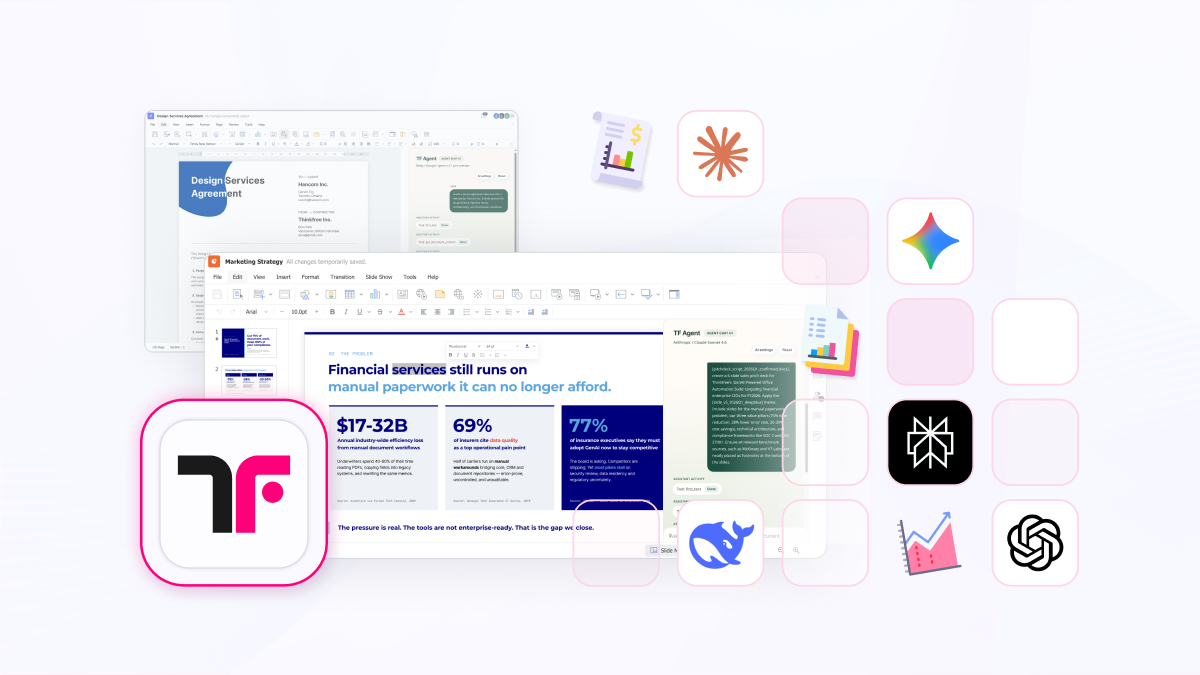
Thinkfree Office is not tied to a specific AI vendor. Organizations can connect public LLMs from providers such as OpenAI, Anthropic, and Google, as well as private LLM and sLLM deployments within their own environments.
This enables organizations to adopt new AI models, optimize costs, and maintain deployment flexibility without rebuilding their document platform whenever their AI strategy changes.
Instead of producing plain-text responses, Thinkfree Office includes a built-in Chat UI that connects to enterprise LLMs and sLLMs, enabling AI-assisted editing within the editor. Users can draft, revise, summarize, compare, or restructure documents through natural language commands without leaving the editor or converting content between tools. This reduces context switching and helps users complete document tasks more efficiently within a familiar editing environment.
Thinkfree Office enables organizations to build document processing workflows that combine enterprise LLMs and sLLMs with a full-featured web office environment.
Instead of moving content between separate AI tools and document editors, users can create, review, compare, and approve documents within a single workspace. This reduces workflow fragmentation while preserving document formatting and governance requirements.
Common document processing workflows include:
By embedding AI capabilities directly into the document editing environment, organizations can streamline document processing while maintaining control over infrastructure, security, and deployment.
Because security, compliance, and operational requirements vary across organizations, Thinkfree AI Document Engine supports multiple deployment options.
In addition, organizations can embed the SDK into the following environments:
Thinkfree Office can be used as a standalone solution or combined with other Thinkfree platforms.
Organizations can combine Thinkfree Office with other Thinkfree platforms to support:
Together, these solutions enable connected document workflows that span document creation, storage, sharing, and collaboration.
Organizations with strict security and compliance requirements can implement AI-assisted document processing within controlled environments.
For example, a company can integrate Thinkfree Office into its internal groupware platform, allowing employees to generate meeting summaries, draft reports, and update policy documents through enterprise-approved LLMs while keeping data within its own infrastructure.
Solution providers can integrate AI-assisted document editing into their products without building a web office platform from scratch. This allows vendors to accelerate time to market and differentiate their offerings with full document capabilities.
Instead of independently developing document rendering, editing, collaboration, and AI integration layers, vendors can embed Thinkfree Office and connect their preferred LLM infrastructure within their own applications.
This approach helps solution providers accelerate product development while maintaining control over tenancy, deployment architecture, and customer data governance.
For example, a Legaltech provider can embed Thinkfree Office into its contract management solution, enabling users to compare contract versions, summarize legal clauses, and revise agreements through natural language commands within the document editor.
A medical writing platform can integrate Thinkfree Office to help researchers and regulatory teams draft clinical study reports and update submission documents.
Similarly, a manufacturing software provider can embed Thinkfree Office into quality management or production systems. Teams can generate work instructions, update standard operating procedures, and revise compliance documents through approved AI models.
Thinkfree Office is well suited for systems integrators, VARs, distributors, and IT consultancies looking to shorten project delivery timelines and strengthen solution competitiveness through reusable architectures.
For example, a systems integrator delivering a digital workplace project can combine Thinkfree Office with enterprise AI infrastructure to provide document editing, review, and collaboration capabilities without developing a custom office platform.
Explore partnership opportunities with Thinkfree and see how our SDK can fit your business goals.
Thinkfree Office enables organizations to connect enterprise LLMs and sLLMs to document workflows through an embeddable Web Office SDK.
Organizations can use it to build AI-powered document workflows while maintaining flexibility across infrastructure and deployment environments.
Explore how our SDK for enterprise AI environments can fit your document processing environment and technology strategy.
Thinkfree Office is an embeddable Web Office SDK that integrates enterprise LLMs and sLLMs into a full-featured document editor. It enables AI-integrated document processing within enterprise systems, SaaS platforms, and proprietary applications.
Thinkfree Office uses an LLM-agnostic architecture and can connect to commercial LLMs, private LLMs, and sLLMs from various providers. Organizations can integrate models deployed within their own infrastructure. They can also use external AI services based on their security and operational requirements.
Organizations can implement a wide range of workflows, including document drafting, contract review, report generation, document comparison, policy updates, knowledge management, collaboration, and internal approval processes.
Yes. Thinkfree Office supports on-premise, private cloud, and hosted API deployments. It can also be implemented in highly controlled environments, including isolated and air-gapped infrastructures, depending on organizational security requirements.
Yes. The SDK can be integrated into SaaS platforms, enterprise applications, and industry-specific solutions.
Yes. Thinkfree Office supports both OOXML and ODF formats, providing compatibility with Microsoft Office-based document environments.
It combines API-based integration capabilities with a web office document editor in a single SDK.
Microsoft Office plug-ins typically extend functionality within an existing Microsoft Office environment. Thinkfree Office is an embeddable Web Office SDK that organizations can integrate directly into their own applications, portals, and SaaS platforms. It provides both document editing capabilities and AI integration within a customizable environment rather than acting as an add-on to an existing office suite.
Thinkfree Office, ONLYOFFICE, and Collabora Online are enterprise web-based document editing platforms supporting OOXML and ODF formats and designed for deployment in on-premise, private cloud, or hybrid environments. They differ mainly in how they integrate AI capabilities and how they extend document editing environments within enterprise systems.
ONLYOFFICE supports external AI provider integrations, allowing organizations to connect third-party AI services for tasks such as content generation, summarization, translation, and document assistance within the editor. Collabora Online enables AI-enabled workflows through integrations with external services and assistant-based features in its document editing environment.
Thinkfree Office combines a document editor with an integrated AI layer designed for enterprise use. It connects enterprise LLMs and sLLMs directly within the editing environment, enabling a unified workflow for generating, refining and finalizing documents in a single workspace.
Through an SDK, Thinkfree Office is designed for native embedding, enabling document editing capabilities to function as an embedded module rather than an externally connected document server. This enables software vendors and enterprises to integrate document editing directly into their applications, SaaS platforms, and business systems.
Genspark is primarily an AI-powered productivity workspace focused on generating presentations, documents, and other content through AI-driven experiences. It also provides built-in editing capabilities for refining AI-generated content. Depending on the use case, organizations may still need additional editing and formatting adjustments before generated content is ready for business use.
Thinkfree Office takes a different approach. It is an embeddable Web Office platform that combines enterprise-grade document editing with AI integration. It supports OOXML and ODF formats, including tables, images, styles, and document layouts, enabling users to generate, edit, and finalize documents within the same environment.
Unlike Genspark, which is designed as an end-user AI workspace, Thinkfree Office enables software vendors and enterprises to embed document editing and AI capabilities directly into their own applications, SaaS platforms, and business systems while maintaining control over deployment, security, governance, and AI model selection.
In short, Genspark is an AI workspace that organizations use, while Thinkfree Office is a platform that organizations can use to build and deliver their own AI document workspaces.
Like this post? Share with others!