
As the use of AI agents grows, so does the amount of content generated by AI. Documents are part of this trend. Some even say traditional office software is now outdated.
But whether an AI-generated document is actually ready for business use is a different question. Formatting breaks, tables fall apart, and the result often is not something you can use right away. Generating text and finishing a document for actual work are different problems, and closing that gap still requires decades of document technology.
That raises a question. Does the document technology needed in the AI era have to be one finished office product?
We don’t think so. Instead of packaging document technology into one finished product, we thought developers should be able to use only the parts their products and workflows need. That idea became the starting point for a new product.
This week, we announced a decision. The document technology we have offered for years under the name Thinkfree Office is now taking a new form as Document Editor SDK. This is more than a name change. In this post, I want to explain who we are building this technology for, how we want them to use it, and why we chose this direction.
Our document technology already runs inside products at many companies. Keeping a document’s original structure and formatting intact through opening, editing, and saving is something we have worked on for decades. But adopting a complete document editor comes with other considerations, including compatibility with existing documents, deployment and operations, and cost.
This matters even more as AI changes how software is built and used. Some teams need document editing itself. Others need only a specific function, such as document processing or integrating documents with AI. When developers have to evaluate an entire product just to use one function, they have fewer ways to apply that technology to their own products.
We have already provided SDKs and APIs that let developers connect Thinkfree’s document technology to their products. What is changing now is how we offer and describe that technology. Instead of putting one finished office product at the center, we decided to let developers choose and combine the document functions their products need.
Even when teams are looking for document functions, what they need can be very different. Some need an environment for editing documents. Others need only a function to convert or process a specific format. Some want AI to edit documents, while others need documents to work alongside other tasks in their application.
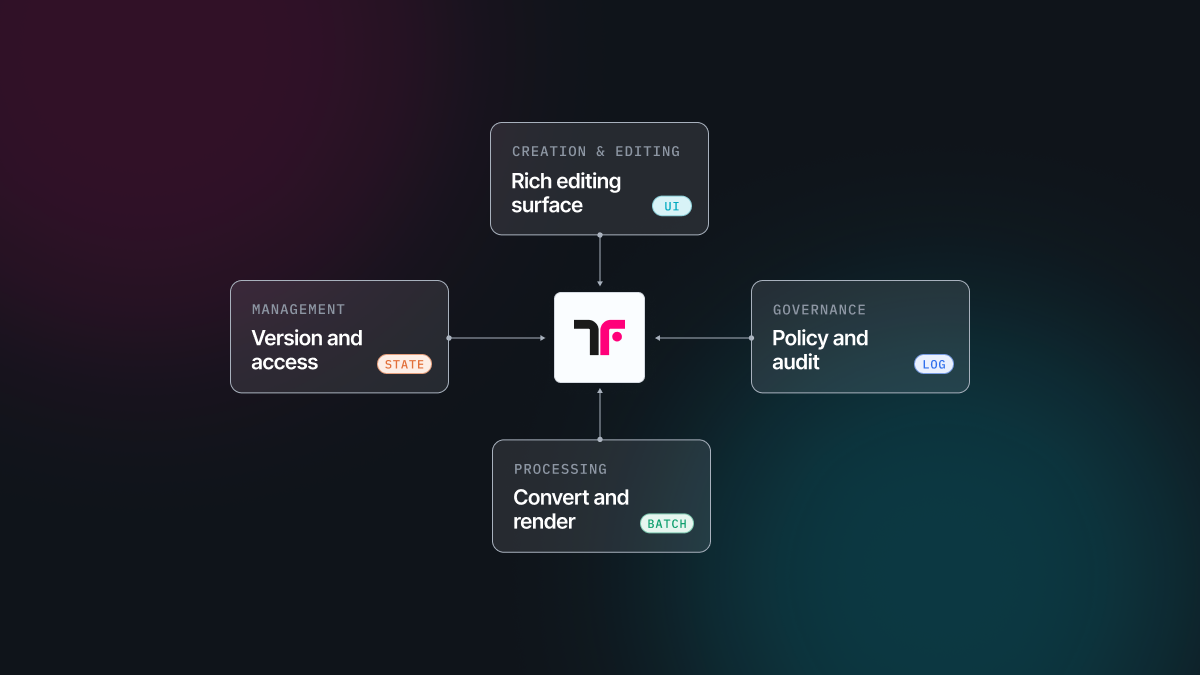
So we started looking at documents as a lifecycle rather than a fixed product. A document does not end with creation and editing. It has to be stored and managed as work moves across a team, and tracked so anyone can see what changed and who changed it. Seen this way, the question is not whether a team can adopt one finished document product. It is whether developers can combine the functions their own product actually needs.
Document Editor SDK is the first part of this lifecycle. It lets developers handle document creation, editing, and conversion in code. We will continue extending the technology for each stage of the lifecycle in the same way.
Document Editor SDK is not a single product. It consists of multiple SDKs for different purposes, including editing and AI agent integration. These capabilities build on the document technology Thinkfree Office has provided over the years.
You can use the Editor SDK to connect an office editor to an existing application and control document content from your own code. To bring AI into that flow, the Editor AI SDK exposes those same editing operations to a model as structured tools. Your agent calls the tool it needs and the editor applies the change to the document. For teams that do not need a full editor, we are also working on a headless path for format processing on the server. We will publish it as part of the same lifecycle once it is ready.
We call this a developer-first document layer. It means you can choose the SDK that fits your purpose, connect it to your product, and test it directly in code. Instead of taking the entire document technology as one block, you can use only the pieces you need. This also makes it possible to use document technology in ways that a single office product may not cover.
You can also choose how to deploy the SDK. Your team can run it on its own infrastructure or use an environment managed by Thinkfree.
Producing a good draft and finishing a document for actual work are two different things. Business documents combine formatting, tables, images, and defined structures. Someone reviews and revises the content, and generated content may also need to be reworked to fit an existing template. Before a document is ready for use, it often goes through several rounds of revision, saving, and sharing.
For teams connecting AI to document work, the challenge is handling this process as a whole. Editing, processing, and review need to continue until the document is ready for use.
That is why we think developers also need a technology layer between AI and documents. Editor AI SDK, part of Document Editor SDK, is designed for this role. It interprets a user’s instruction and calls the relevant document tool. Your application decides which model to use, which tasks to automate, and when to ask for user approval.
We now define Thinkfree’s document technology as a document layer that developers can use in their own products. This change may feel unfamiliar to people who have known us as an office software company.
We chose this direction because we believe it is a more honest way to describe what we actually build. The name “office” brings one finished product to mind, but the technology we have built over the years is not confined to a single application. From here, we want to focus more on making that technology available for developers to use in their own products.
This does not change the value of our document technology. It changes how developers discover and experience it. We want developers who are new to Thinkfree to be able to work with the technology in their own products and code.
I think the clearest way to understand this change is to see it in code.
As part of this transition, we are publishing the Document Editor SDK’s documentation and Playground. The way developers understand and experience a technology is part of the product itself. With the SDK, you can see how document functions connect to your app and how AI can work with documents.
For decades, we have focused on making documents work across different formats, applications, and workflows. Now, we are making that technology available for developers to use in their own products and workflows. We look forward to seeing how developers use it in ways we have not yet considered.
See what Document Editor SDK includes.
Need help with your integration?
Like this post? Share with others!